







Question: Last year Janet purchased a $1,000 face value corporate bond with an 11% annual coupon rate and a 30-year maturity. At the time of the



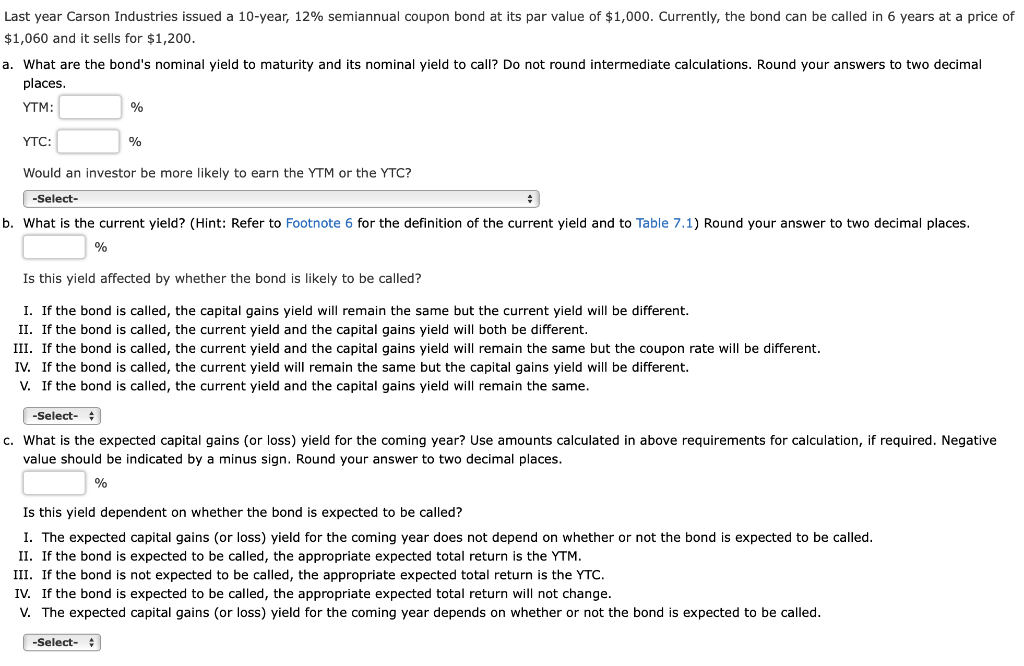
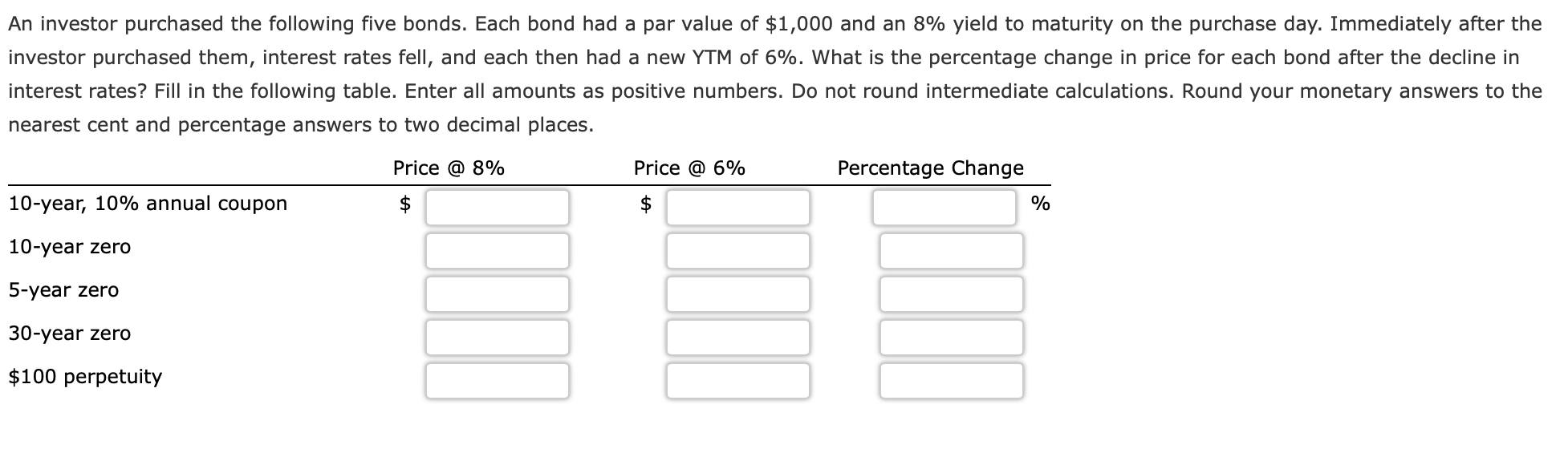
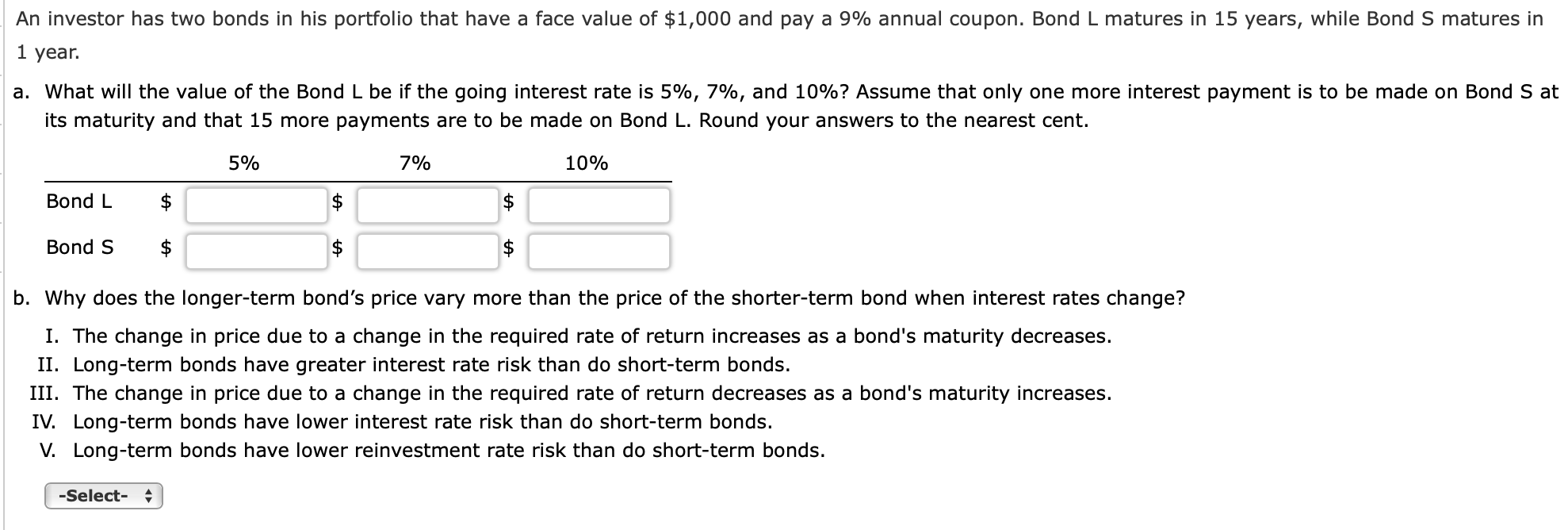
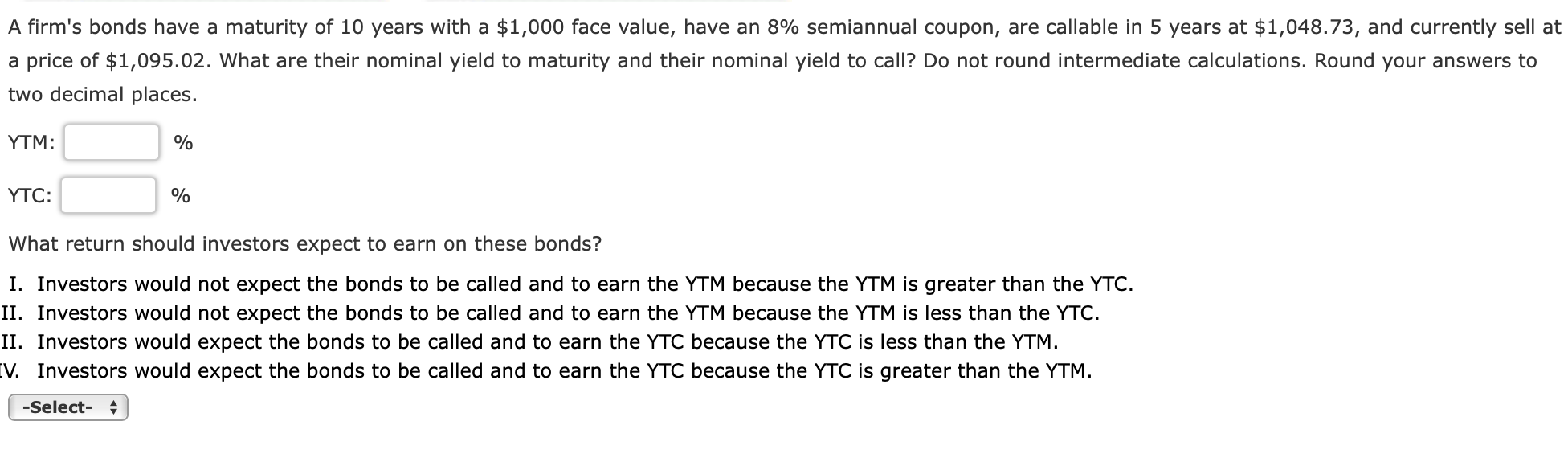



Last year Janet purchased a $1,000 face value corporate bond with an 11% annual coupon rate and a 30-year maturity. At the time of the purchase, it had an expected yield to maturity of 11.72%. If Janet sold the bond today for $937.07, what rate of return would she have earned for the past year? Do not round intermediate calculations. Round your answer to two decimal places. % Bond X is noncallable and has 20 years to maturity, an 11% annual coupon, and a $1,000 par value. Your required return on Bond X is 10%; if you buy it, you plan to hold it for 5 years. You (and the market) have expectations that in 5 years, the yield to maturity on a 15-year bond with similar risk will be 10.5%. How much should you be willing to pay for Bond X today? (Hint: You will need to know how much the bond will be worth at the end of 5 years.) Do not round intermediate calculations. Round your answer to the nearest cent. A 6% semiannual coupon bond matures in 4 years. The bond has a face value of $1,000 and a current yield of 6.6863%. What are the bond's price and YTM? (Hint: Refer to Footnote 6 for the definition of the current yield and to Table 7.1) Do not round intermediate calculations. Round your answer for the bond's price to the nearest cent and for YTM to two decimal places. Bond's price: $ YTM: % Last year Carson Industries issued a 10-year, 12% semiannual coupon bond at its par value of $1,000. Currently, the bond can be called in 6 years at a price of $1,060 and it sells for $1,200. a. What are the bond's nominal yield to maturity and its nominal yield to call? Do not round intermediate calculations. Round your answers to two decimal places. YTM: % YTC: % Would an investor be more likely to earn the YTM or the YTC? -Select- b. What is the current yield? (Hint: Refer to Footnote 6 for the definition of the current yield and to Table 7.1) Round your answer to two decimal places. % Is this yield affected by whether the bond is likely to be called? I. If the bond is called, the capital gains yield will remain the same but the current yield will be different. II. If the bond is called, the current yield and the capital gains yield will both be different. III. If the bond is called, the current yield and the capital gains yield will remain the same but the coupon rate will be different. IV. If the bond is called, the current yield will remain the same but the capital gains yield will be different. V. If the bond is called, the current yield and the capital gains yield will remain the same. -Select- c. What is the expected capital gains (or loss) yield for the coming year? Use amounts calculated in above requirements for calculation, if required. Negative value should be indicated by a minus sign. Round your answer to two decimal places. % Is this yield dependent on whether the bond is expected to be called? I. The expected capital gains (or loss) yield for the coming year does not depend on whether or not the bond is expected to be called. II. If the bond is expected to be called, the appropriate expected total return is the YTM. III. If the bond is not expected to be called, the appropriate expected total return is the YTC. IV. If the bond is expected to be called, the appropriate expected total return will not change. V. The expected capital gains (or loss) yield for the coming year depends on whether or not the bond is expected to be called. -Select- An investor purchased the following five bonds. Each bond had a par value of $1,000 and an 8% yield to maturity on the purchase day. Immediately after the investor purchased them, interest rates fell, and each then had a new YTM of 6%. What is the percentage change in price for each bond after the decline in interest rates? Fill in the following table. Enter all amounts as positive numbers. Do not round intermediate calculations. Round your monetary answers to the nearest cent and percentage answers to two decimal places. Price @ 8% Price @ 6% Percentage Change 10-year, 10% annual coupon $ % 10-year zero 5-year zero 30-year zero $100 perpetuity An investor has two bonds in his portfolio that have a face value of $1,000 and pay a 9% annual coupon. Bond L matures in 15 years, while Bond S matures in 1 year. a. What will the value of the Bond L be if the going interest rate is 5%, 7%, and 10%? Assume that only one more interest payment is to be made on Bond S at its maturity and that 15 more payments are to be made on Bond L. Round your answers to the nearest cent. 5% 7% 10% Bond L $ Bond S $ b. Why does the longer-term bond's price vary more than the price of the shorter-term bond when interest rates change? I. The change in price due to a change in the required rate of return increases as a bond's maturity decreases. II. Long-term bonds have greater interest rate risk than do short-term bonds. III. The change in price due to a change in the required rate of return decreases as a bond's maturity increases. IV. Long-term bonds have lower interest rate risk than do short-term bonds. V. Long-term bonds have lower reinvestment rate risk than do short-term bonds. -Select- 4 A firm's bonds have a maturity of 10 years with a $1,000 face value, have an 8% semiannual coupon, are callable in 5 years at $1,048.73, and currently sell at a price of $1,095.02. What are their nominal yield to maturity and their nominal yield to call? Do not round intermediate calculations. Round your answers to two decimal places. YTM: % YTC: % What return should investors expect to earn on these bonds? I. Investors would not expect the bonds to be called and to earn the YTM because the YTM is greater than the YTC. II. Investors would not expect the bonds to be called and to earn the YTM because the YTM is less than the YTC. II. Investors would expect the bonds to be called and to earn the YTC because the YTC is less than the YTM. V. Investors would expect the bonds to be called and to earn the YTC because the YTC is greater than the YTM. -Select- Nesmith Corporation's outstanding bonds have a $1,000 par value, a 7% semiannual coupon, 11 years to maturity, and an 11% YTM. What is the bond's price? Round your answer to the nearest cent. tA A bond has a $1,000 par value, 8 years to maturity, and a 7% annual coupon and sells for $980. a. What is its yield to maturity (YTM)? Round your answer to two decimal places. % b. Assume that the yield to maturity remains constant for the next five years. What will the price be 5 years from today? Do not round intermediate calculations. Round your answer to the nearest cent. $ Madsen Motors's bonds have 8 years remaining to maturity. Interest is paid annually, they have a $1,000 par value, the coupon interest rate is 12%, and the yield to maturity is 13%. What is the bond's current market price? Round your answer to the nearest cent. $
Step by Step Solution
There are 3 Steps involved in it

Get step-by-step solutions from verified subject matter experts
 Study Help