







Question: layer a is close packed arrays, need help with following questions B. Close packed anion arrays. See also Klein, pp. 66-68 (pp. 73-75 in 22nd
layer a is close packed arrays, need help with following questions
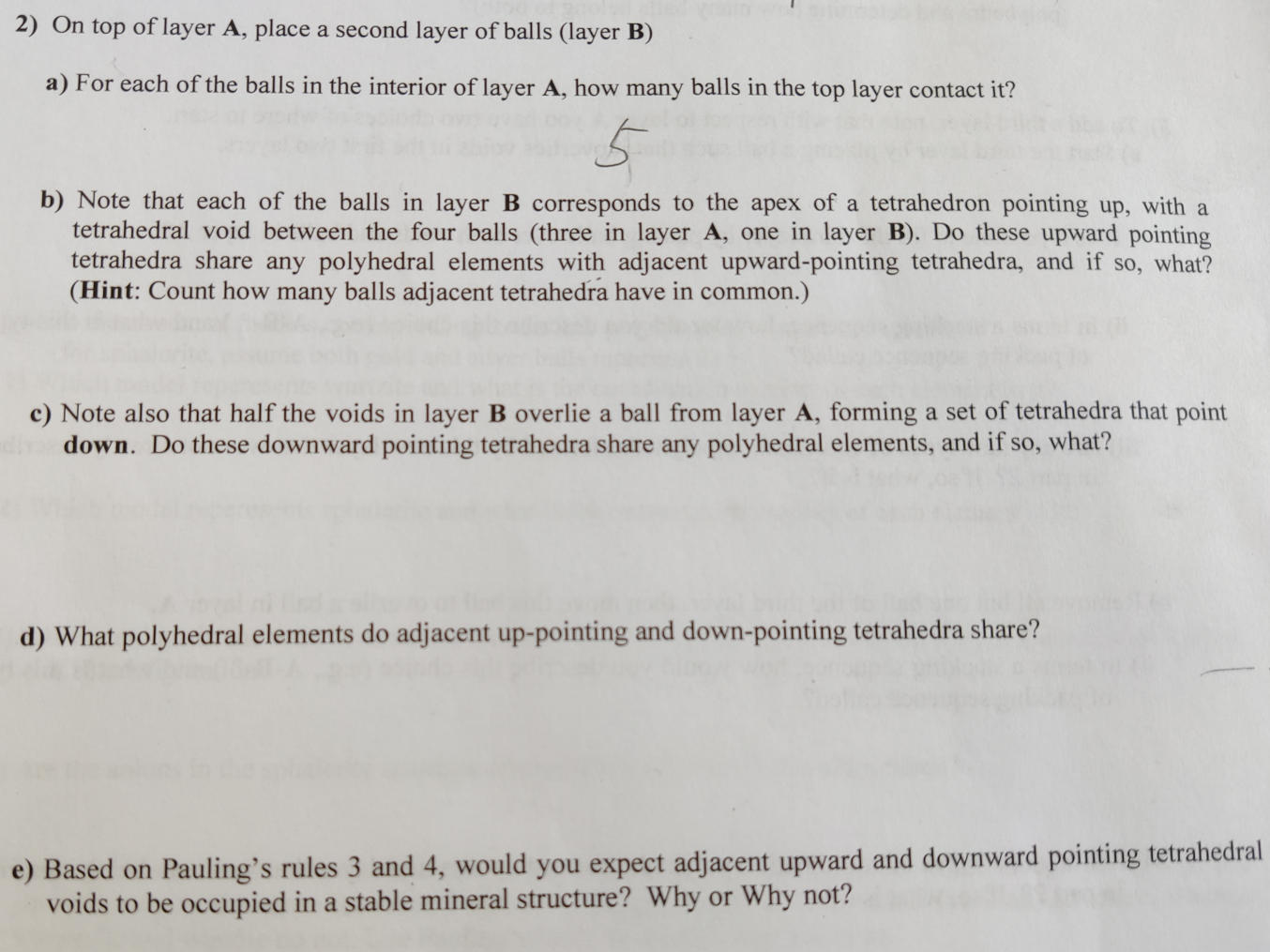
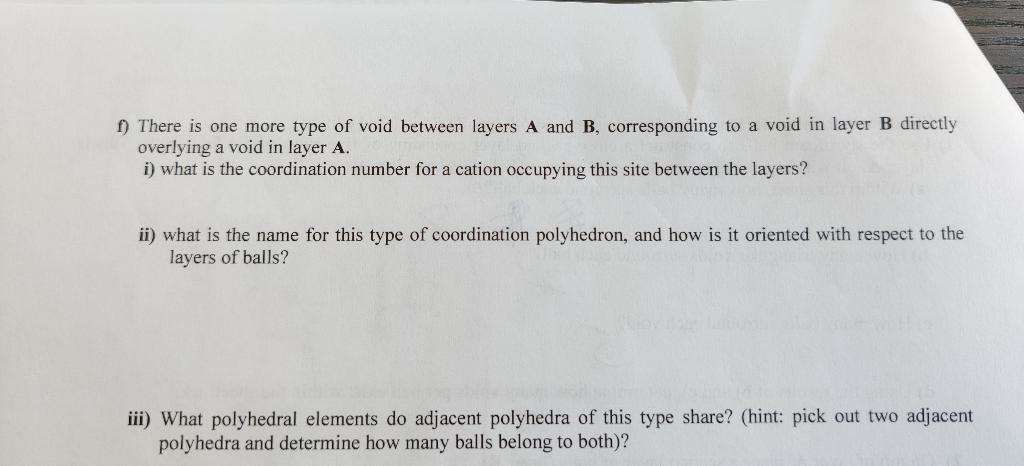
B. Close packed anion arrays. See also Klein, pp. 66-68 (pp. 73-75 in 22nd edition) 1) Use the styrofoam balls to construct a close-packed layer consisting of five rows of 5,4,5,4,5 balls. This is layer A. It will be helpful to use the wood frame to hold this layer in place. 2) On top of layer A, place a second layer of balls (layer B) a) For each of the balls in the interior of layer A, how many balls in the top layer contact it? 5 b) Note that each of the balls in layer B corresponds to the apex of a tetrahedron pointing up, with a tetrahedral void between the four balls (three in layer A, one in layer B). Do these upward pointing tetrahedra share any polyhedral elements with adjacent upward-pointing tetrahedra, and if so, what? (Hint: Count how many balls adjacent tetrahedra have in common.) c) Note also that half the voids in layer B overlie a ball from layer A, forming a set of tetrahedra that point down. Do these downward pointing tetrahedra share any polyhedral elements, and if so, what? d) What polyhedral elements do adjacent up-pointing and down-pointing tetrahedra share? e) Based on Pauling's rules 3 and 4, would you expect adjacent upward and downward pointing tetrahedral voids to be occupied in a stable mineral structure? Why or Why not? f) There is one more type of void between layers A and B, corresponding to a void in layer B directly overlying a void in layer A. i) what is the coordination number for a cation occupying this site between the layers? ii) what is the name for this type of coordination polyhedron, and how is it oriented with respect to the layers of balls? iii) What polyhedral elements do adjacent polyhedra of this type share? (hint: pick out two adjacent polyhedra and determine how many balls belong to both)
Step by Step Solution
There are 3 Steps involved in it

Get step-by-step solutions from verified subject matter experts
 Study Help