







Question: LC-3 ASSEMBLY LANGUAGE CODE TEMPLATE: .ORIG x3000 ; Program begins here ;------------- ;Instructions ;------------- LD R6, Convert_addr ; R6 HALT ;--------------- ;Data ;--------------- Convert_addr .FILL
LC-3 ASSEMBLY LANGUAGE
CODE TEMPLATE:
.ORIG x3000 ; Program begins here ;------------- ;Instructions ;------------- LD R6, Convert_addr ; R6
HALT ;--------------- ;Data ;--------------- Convert_addr .FILL xD000 ; The address of where to find the data
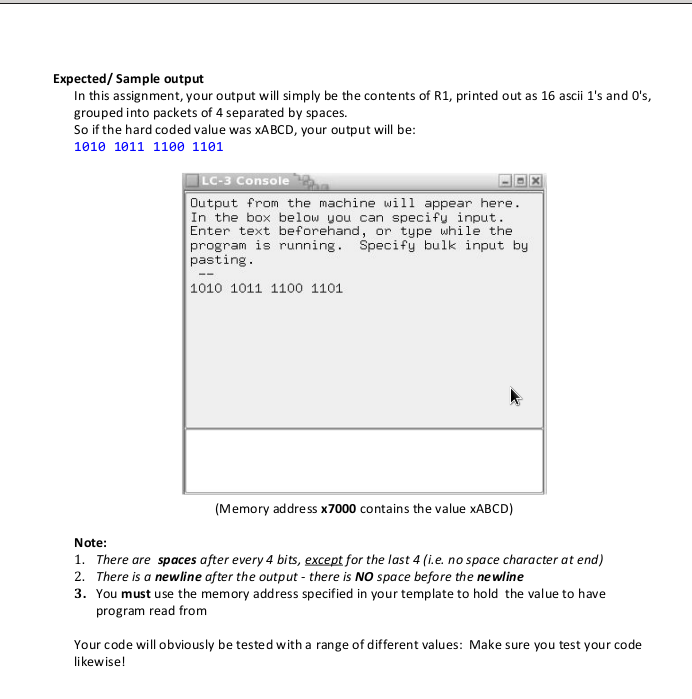
.ORIG xD000 ; Remote data Convert .FILL xABCD ;
;--------------- ;END of PROGRAM ;--------------- .END
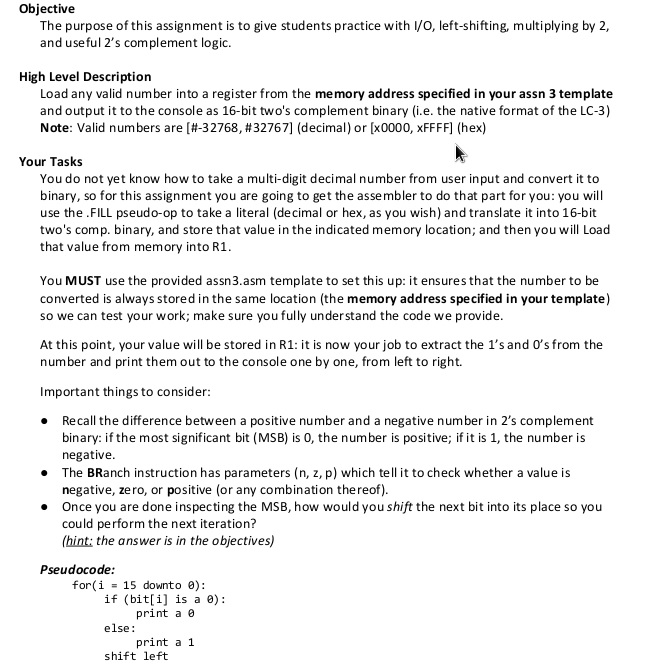
Objective The purpose of this assignment is to give students practice with I/O, left-shifting, multiplying by 2, and useful 2's complement logic High Level Description Load any valid number into a register from the memory address specified in your assn 3 template and output it to the console as 16-bit two's complement binary (i.e. the native format of the LC-3) Note: Valid numbers are [ 32768, #32767] (decimal) or [x0000, xFFFF] (hex) Your Tasks You do not yet know how to take a multi-digit decimal number from user input and convert it to binary, so for this assignment you are going to get the assembler to do that part for you: you will use the .FILL pseudo-op to take a literal (decimal or hex, as you wish) and translate it into 16-bit two's comp. binary, and store that value in the indicated memory location; and then you will Load that value from memory into R1 You MUST use the provided assn3.asm template to set this up: it ensures that the number to be converted is always stored in the same location (the memory address specified in your template) so we can test your work; make sure you fully understand the code we provide At this point, your value will be stored in R1: it is now your job to extract the 1'sand O's from the number and print them out to the console one by one, from left to right. Important things to consider Recall the difference between a positive number and a negative number in 2's complement binary: if the most significant bit (MSB) is 0, the number is positive; if it is 1, the number is negative The BRanch instruction has parameters (n, z, p) which tell it to check whether a value is negative, zero, or positive (or any combination thereof) Once you are done inspecting the MSB, how would you shift the next bit into its place so you could perform the next iteration? (hint: the answer is in the objectives) . Pseudocode for(i = 15 downto 0): if (bit[i] is a 0) print a eise print a 1 shift left
Step by Step Solution
There are 3 Steps involved in it

Get step-by-step solutions from verified subject matter experts
 Study Help