



Question: Lead and copper pipes are sometimes found in drinking water distribution systems and premise plumbing, especially in older buildings. Corrosion of copper and lead pipes
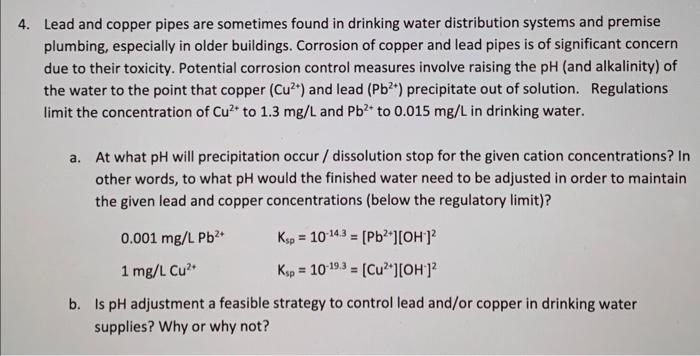
Lead and copper pipes are sometimes found in drinking water distribution systems and premise plumbing, especially in older buildings. Corrosion of copper and lead pipes is of significant concern due to their toxicity. Potential corrosion control measures involve raising the pH (and alkalinity) of the water to the point that copper (Cu2+) and lead (Pb2+) precipitate out of solution. Regulations limit the concentration of Cu2+ to 1.3mg/L and Pb2+ to 0.015mg/L in drinking water. a. At what pH will precipitation occur / dissolution stop for the given cation concentrations? In other words, to what pH would the finished water need to be adjusted in order to maintain the given lead and copper concentrations (below the regulatory limit)? 0.001mg/LPb2+1mg/LCu2+Ksp=1014.3=[Pb2+][OH]2Ksp=1019.3=[Cu2+][OH]2 b. Is pH adjustment a feasible strategy to control lead and/or copper in drinking water supplies? Why or why not
Step by Step Solution
There are 3 Steps involved in it

Get step-by-step solutions from verified subject matter experts