



Question: Learn It: Chapter 06 Revising Business Messages: In Section 6-3, we will cover how to enhance readability through document design. White space, which refers to
Learn It: Chapter 06 Revising Business Messages:
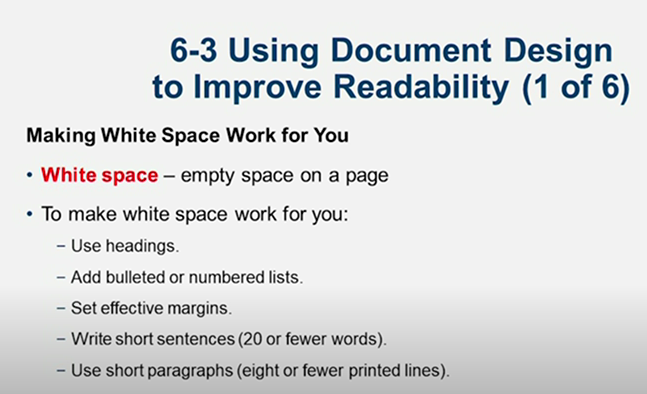
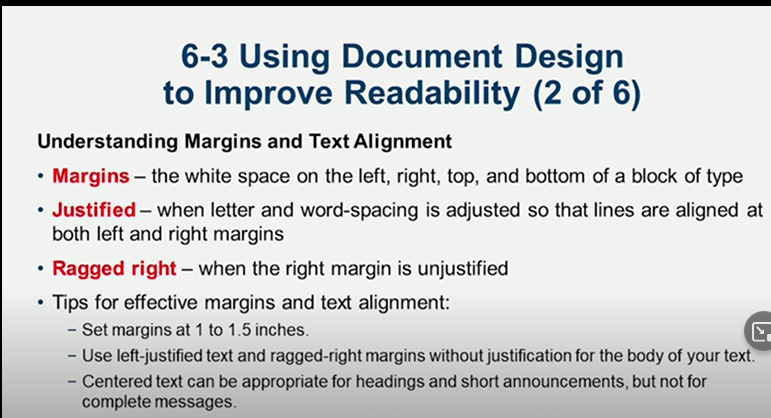
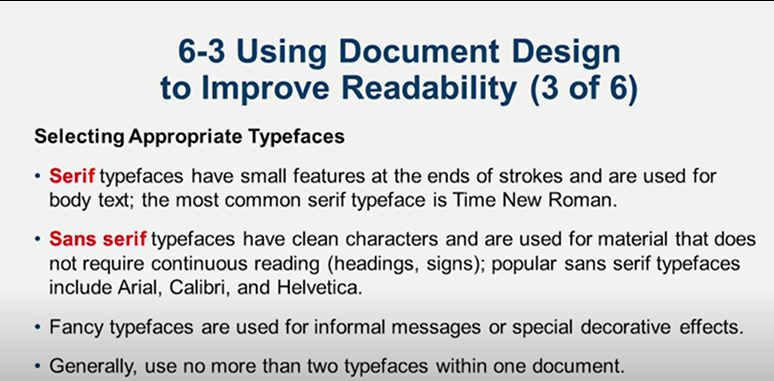
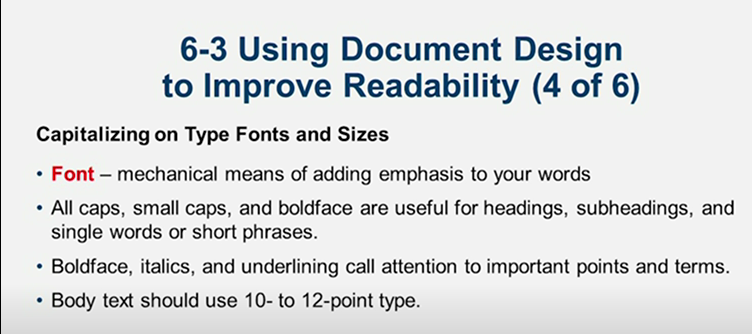
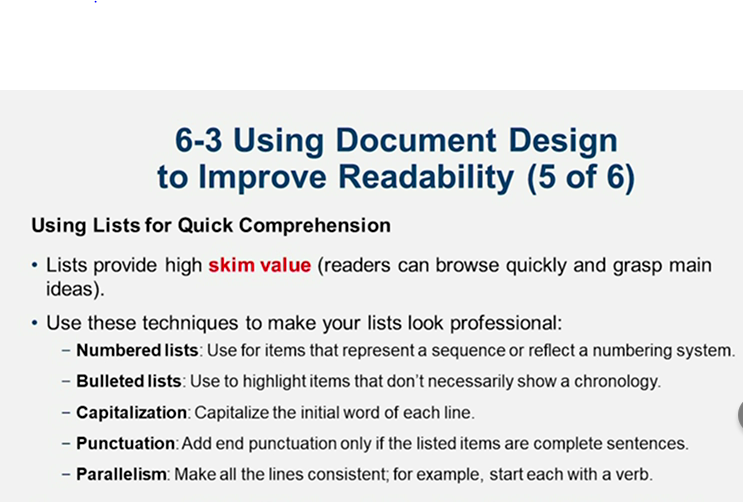
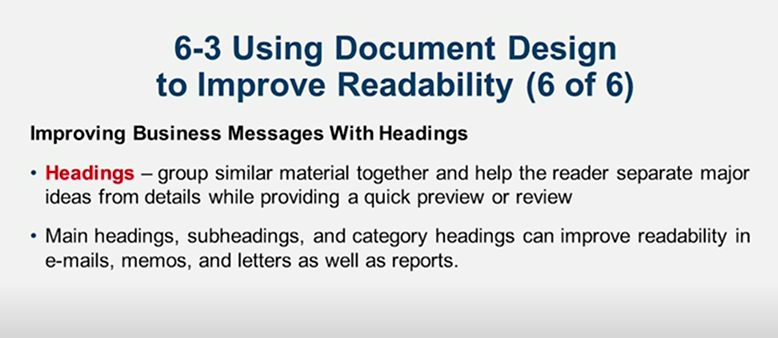
In Section 6-3, we will cover how to enhance readability through document design. White space, which refers to the empty space on a page, can be used effectively to improve readability by using headings, adding bulleted or numbered lists, setting effective margins, writing short sentences of 20 or fewer words, and using short paragraphs of eight or fewer printed lines. Margins are the white space on the left, right, top, and bottom of a block of type. Margins are considered justified when letter and word-spacing is adjusted so that lines are aligned at both left and right margins. Ragged right describes when the right margin is unjustified. Margins and margin alignment are important aspects of readability. For most documents, set margins at 1 to 1.5 inches and use left-justified text and ragged-right margins without justification for the body of your writing. Centered text can be appropriate for headings and short announcements, but not for complete messages. A wide range of typefaces are available and should be selected appropriately based upon the purpose of your communication. Serif typefaces have small features at the ends of strokes, while sans serif typefaces have clean characters. In business communication, you'll generally use traditional serif typefaces for body text and all-purpose sans serif typefaces for material that does not require continuous reading, such as headings or signs. The most common serif typeface is Times New Roman. Popular sans serif typefaces include Arial, Calibri, and Helvetica. Fancy typefaces are normally reserved for informal messages or special decorative effects. A good rule of thumb is to use no more than two typefaces within one document. A font is a mechanical means of adding emphasis to your words. All caps, small caps, and boldface are all useful font styles for enhancing headings, subheadings, and single words or short phrases. Boldface, italics, and underlining can be used to call attention to important points and terms. Type size is also an important consideration. Body text should use 10- to 12-point type. While smaller type enables you to fit more words into a space, it can make text look dense and unappealing. On the other hand, overly large type (14 points or more) looks amateurish and is only appropriate for headings. Lists provide high skim value, meaning readers can browse quickly and grasp your main ideas. They improve readability, understanding, and retention and force the writer to organize ideas and write efficiently. Use these techniques for professional-looking lists: Numbered lists: Use for items that represent a sequence or reflect a numbering system. Bulleted lists: Use to highlight items that don't necessarily show a chronology. Capitalization: Capitalize the initial word of each line. Punctuation: Add end punctuation only if the listed items are complete sentences. Parallelism: Make all the lines of your list consistent; for example, start each with a verb. Business messages can also be improved by grouping similar material together with headings, helping the reader separate major ideas from details, providing a quick preview or review, and enabling busy readers to skim familiar or less important details. The use of main headings, subheadings, and category headings can improve readability in e-mails, memos, and letters as well as in reports.
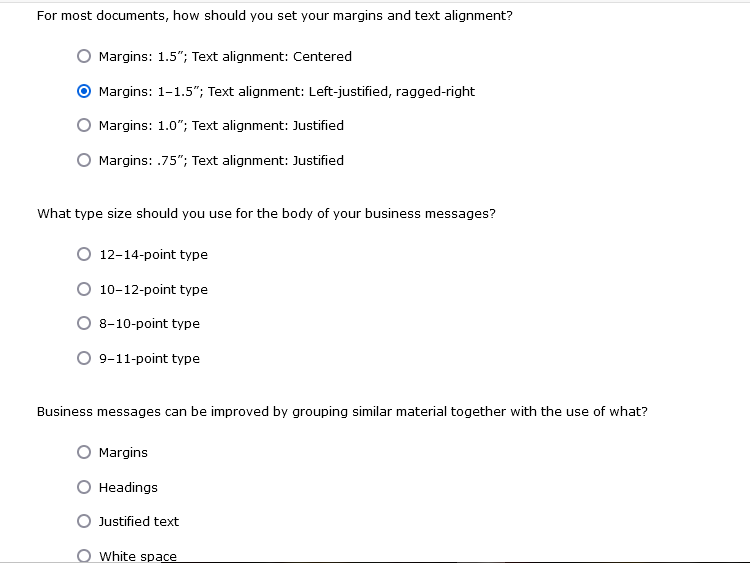
For most documents, how should you set your margins and text alignment?
Margins: 1.5; Text alignment: Centered
Margins: 11.5; Text alignment: Left-justified, ragged-right
Margins: 1.0; Text alignment: Justified
Margins: .75; Text alignment: Justified
What type size should you use for the body of your business messages?
1214-point type
1012-point type
810-point type
911-point type
Business messages can be improved by grouping similar material together with the use of what?
Margins
Headings
Justified text
White space
Step by Step Solution
There are 3 Steps involved in it

Get step-by-step solutions from verified subject matter experts