







Question: Learning Goal: To apply Problem - Solving Strategy 2 2 1 Alternating - current circuits. You have a 2 0 0 - resistor, a 0
Learning Goal:
To apply ProblemSolving Strategy Alternatingcurrent circuits.
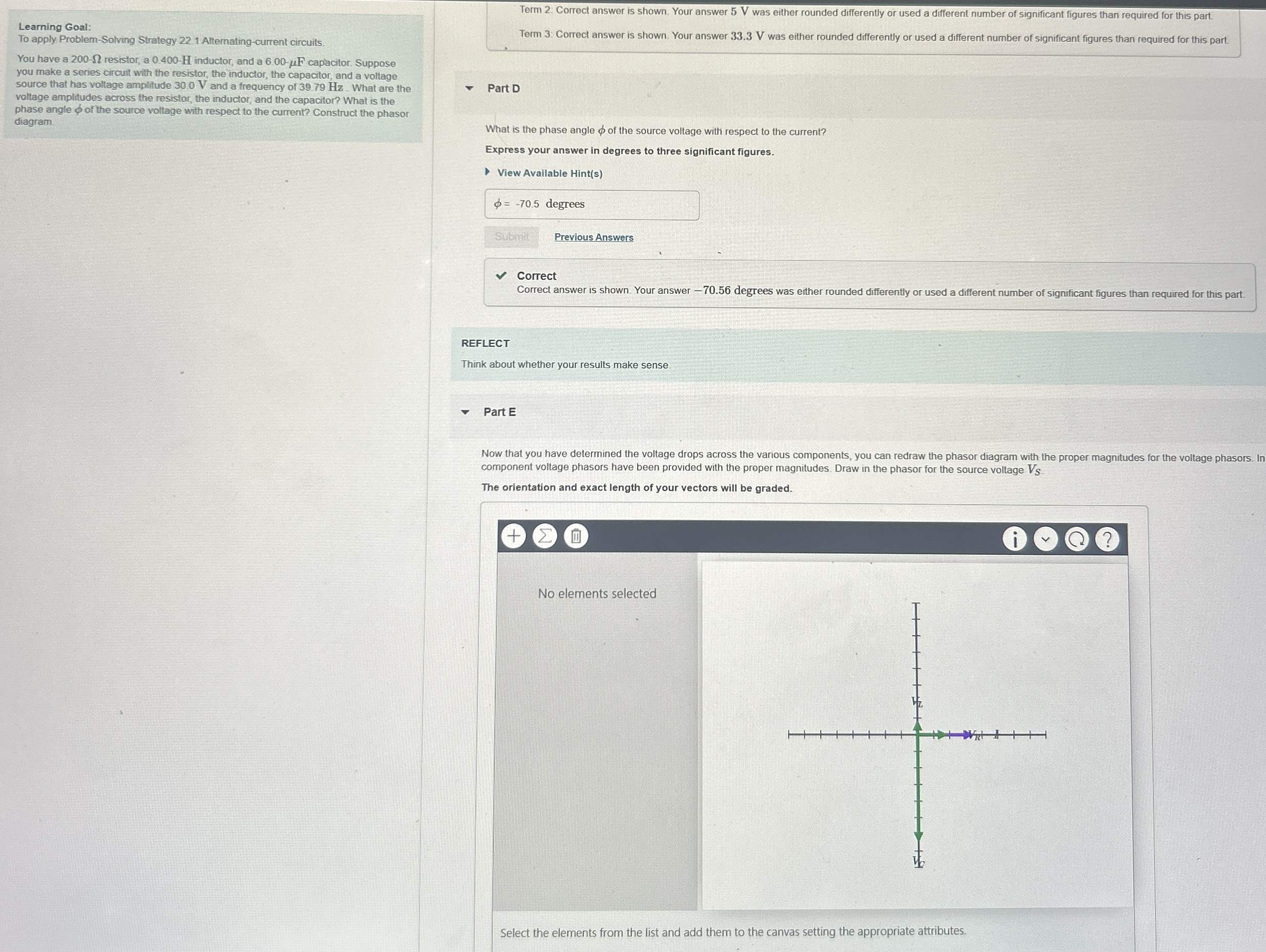
You have a resistor, a inductor, and a capacitor. Suppose you make a series circuit with the resistor, the inductor, the capacitor, and a voltage source that has voltage amplitude V and a frequency of Hz What are the voltage amplitudes across the resistor, the inductor, and the capacitor? What is the phase angle of the source voltage with respect to the current? Construct the phasor diagram
Term : Correct answer is shown. Your answer V was either rounded differently or used a different number of significant figures than required for this part.
Term : Correct answer is shown. Your answer V was either rounded differently or used a different number of significant figures than required for this part.
Part D
What is the phase angle of the source voltage with respect to the current?
Express your answer in degrees to three significant figures.
View Available Hints
Previous Answers
Correct
Correct answer is shown. Your answer degrees was either rounded differently or used a different number of significant figures than required for this part
REFLECT
Think about whether your results make sense.
Part E
Now that you have determined the voltage drops across the various components, you can redraw the phasor diagram with the proper magnitudes for the voltage phasors. In component voltage phasors have been provided with the proper magnitudes. Draw in the phasor for the source voltage
The orientation and exact length of your vectors will be graded.
No elements selected
Select the elements from the list and add them to the canvas setting the appropriate attributes.
Step by Step Solution
There are 3 Steps involved in it
1 Expert Approved Answer
Step: 1 Unlock

Question Has Been Solved by an Expert!
Get step-by-step solutions from verified subject matter experts
Step: 2 Unlock
Step: 3 Unlock
 Study Help