







Question: Learning Goal: To practice Problem - Solving Strategy: Simple Harmonic Motion I: Describing Motion. A block of mass 5 0 0 g is attached to
Learning Goal:
To practice ProblemSolving Strategy: Simple Harmonic Motion I: Describing Motion.
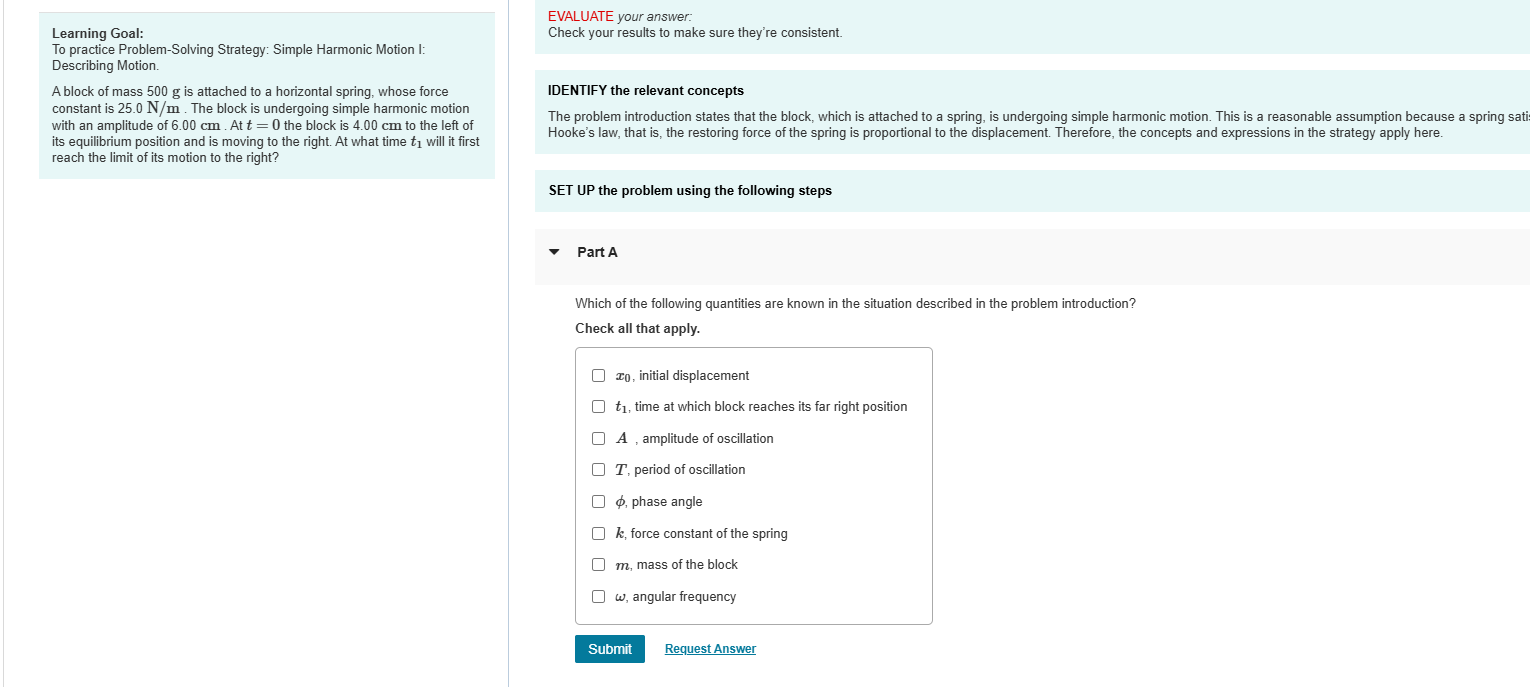
A block of mass g is attached to a horizontal spring, whose force constant is mathrm~Nmathrmm The block is undergoing simple harmonic motion with an amplitude of cm At t the block is cm to the left of its equilibrium position and is moving to the right. At what time t will it first reach the limit of its motion to the right?
EVALUATE your answer:
Check your results to make sure they're consistent.
IDENTIFY the relevant concepts
The problem introduction states that the block, which is attached to a spring, is undergoing simple harmonic motion. This is a reasonable assumption because a spring sati Hooke's law, that is the restoring force of the spring is proportional to the displacement. Therefore, the concepts and expressions in the strategy apply here.
SET UP the problem using the following steps
Part A
Which of the following quantities are known in the situation described in the problem introduction?
Check all that apply.
x initial displacement
t time at which block reaches its far right position
A amplitude of oscillation
T period of oscillation
phi phase angle
boldsymbolk force constant of the spring
m mass of the block
omega angular frequency
Step by Step Solution
There are 3 Steps involved in it
1 Expert Approved Answer
Step: 1 Unlock

Question Has Been Solved by an Expert!
Get step-by-step solutions from verified subject matter experts
Step: 2 Unlock
Step: 3 Unlock
 Study Help