







Question: lem: Let a > 1, and g(a) is a function of a Consider the following maximization prob- = max f(x; a) a logr +
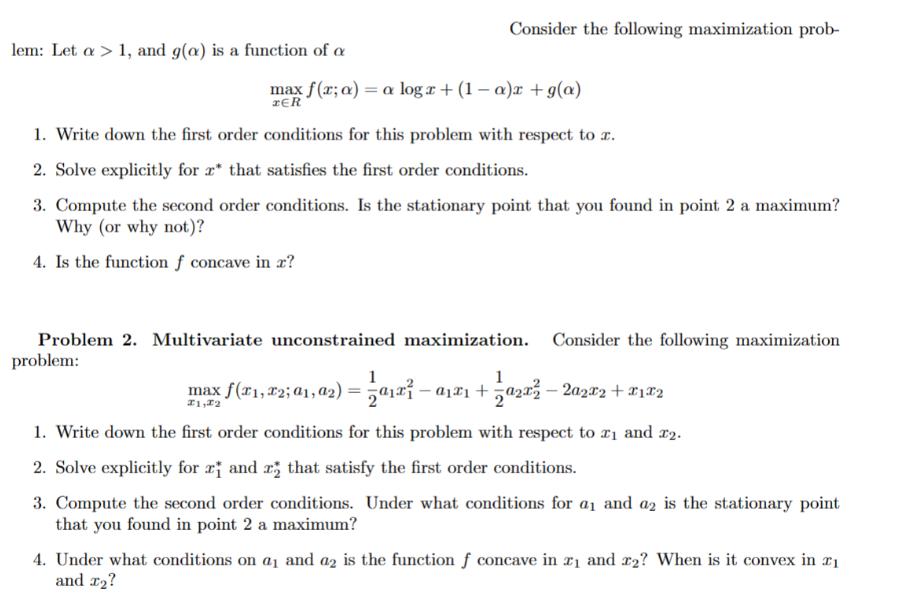
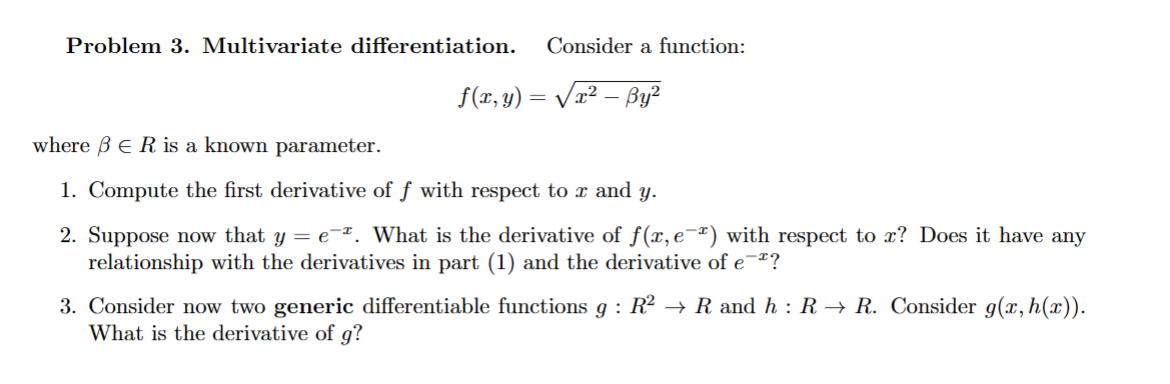
lem: Let a > 1, and g(a) is a function of a Consider the following maximization prob- = max f(x; a) a logr + (1a)x +9(a) ZER 1. Write down the first order conditions for this problem with respect to x. 2. Solve explicitly for a* that satisfies the first order conditions. 3. Compute the second order conditions. Is the stationary point that you found in point 2 a maximum? Why (or why not)? 4. Is the function f concave in x? Problem 2. Multivariate unconstrained maximization. problem: 1 1 Consider the following maximization max f(x1, x2; 91, 92) = x - 11+22-202*+*1*2 21,22 1. Write down the first order conditions for this problem with respect to 21 and 22. 2. Solve explicitly for and that satisfy the first order conditions. 3. Compute the second order conditions. Under what conditions for a and a2 is the stationary point that you found in point 2 a maximum? 4. Under what conditions on a and a2 is the function f concave in 1 and 22? When is it convex in 21 and x2? Problem 3. Multivariate differentiation. Consider a function: f(x,y) = x - By where ER is a known parameter. 1. Compute the first derivative off with respect to x and y. 2. Suppose now that y = e. What is the derivative of f(x, ex) with respect to x? Does it have any relationship with the derivatives in part (1) and the derivative of e? 3. Consider now two generic differentiable functions 9: R R and h: R R. Consider g(x, h(x)). What is the derivative of g?
Step by Step Solution
There are 3 Steps involved in it

Get step-by-step solutions from verified subject matter experts
 Study Help