



Question: Length, 1 (m) Resistance, R ( 2 ) 1 1.1 22.74m 2 3.9 79.07m 3 4.4 88.49m A 6 0.12m 5 7 0.14m 6 7.9
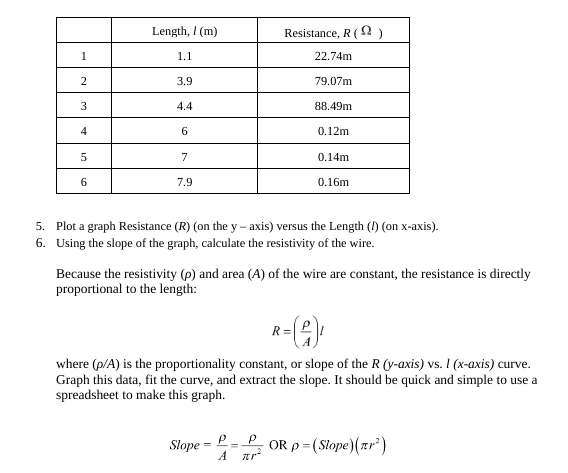
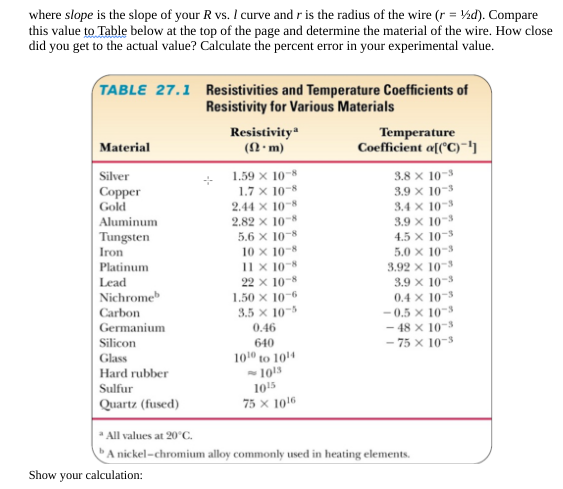
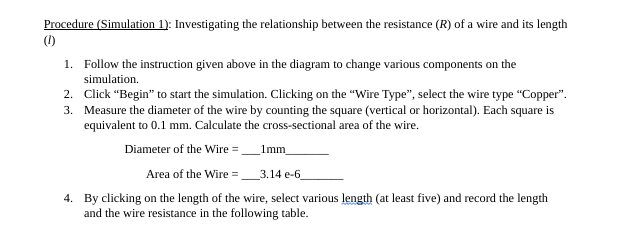
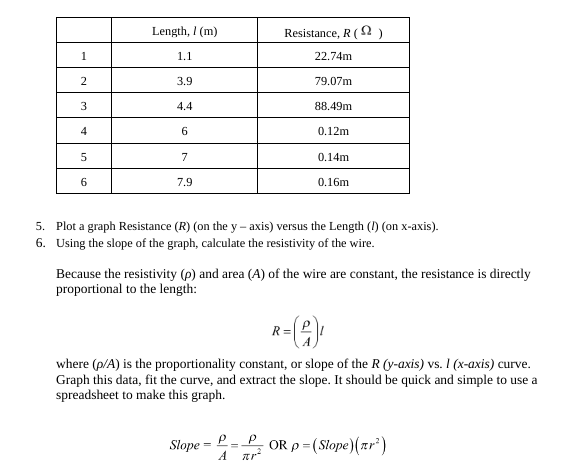
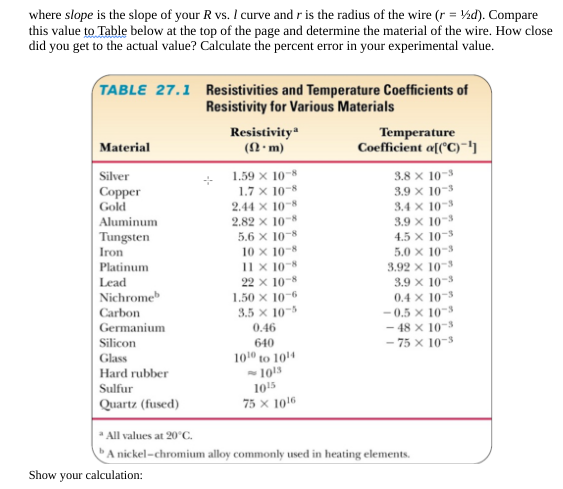
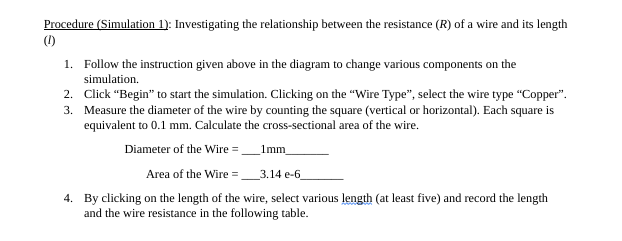
Length, 1 (m) Resistance, R ( 2 ) 1 1.1 22.74m 2 3.9 79.07m 3 4.4 88.49m A 6 0.12m 5 7 0.14m 6 7.9 0.16m 5. Plot a graph Resistance (R) (on the y - axis) versus the Length ()) (on x-axis). 6. Using the slope of the graph, calculate the resistivity of the wire. Because the resistivity (p) and area (A) of the wire are constant, the resistance is directly proportional to the length: R = [ where (p/A) is the proportionality constant, or slope of the R (y-axis) vs. I (x-axis) curve. Graph this data, fit the curve, and extract the slope. It should be quick and simple to use a spreadsheet to make this graph. Slope = 2 - OR p = ( Slope) (mr]) Awhere slope is the slope of your R vs. I curve and r is the radius of the wire (r = 12d). Compare this value to Table below at the top of the page and determine the material of the wire. How close did you get to the actual value? Calculate the percent error in your experimental value. TABLE 27.1 Resistivities and Temperature Coefficients of Resistivity for Various Materials Resistivity Temperature Material (0 . m) Coefficient a[(C)='] Silver 1.59 X 10⁻⁸ 3.8 x 10⁻³ Copper 1.7 x 10⁻⁸ 3.9 x 10⁻³ Gold 2.44 X 10⁻⁸ 3.4 x 10⁻³ Aluminum 2.82 x 10⁻⁸ 3.9 x 10⁻³ Tungsten 5.6 X 10⁻⁸ 4.5 x 10⁻³ Iron 10 x 10-8 5.0 x 10⁻³ Platinum 11 X 10-8 3.92 x 10⁻³ Lead 22 X 10-8 3.9 X 10⁻³ Nichrome 1.50 x 10⁻⁶ 0.4 X 10⁻³ Carbon 3.5 x 10⁻⁵ - 0.5 x 10⁻³ Germanium 0.46 - 48 X 10-3 Silicon 640 - 75 X 10-3 Glass 1010 to 1014 Hard rubber -1013 Sulfur Quartz (fused) 75 x 1016 * All values at 20"C. A nickel-chromium alloy commonly used in heating elements. Show your calculation:Procedure (Simulation 1): Investigating the relationship between the resistance (R) of a wire and its length 1. Follow the instruction given above in the diagram to change various components on the simulation. 2. Click "Begin" to start the simulation. Clicking on the "Wire Type", select the wire type "Copper". 3. Measure the diameter of the wire by counting the square (vertical or horizontal). Each square is equivalent to 0.1 mm. Calculate the cross-sectional area of the wire. Diameter of the Wire =_ 1mm Area of the Wire = 3.14 e-6 4. By clicking on the length of the wire, select various length (at least five) and record the length and the wire resistance in the following table
Step by Step Solution
There are 3 Steps involved in it

Get step-by-step solutions from verified subject matter experts