







Question: = Let {0,1}. The reverse of a string a denoted by rev(r) and is defined by the following recursive rule: rev(c) = c Vr,
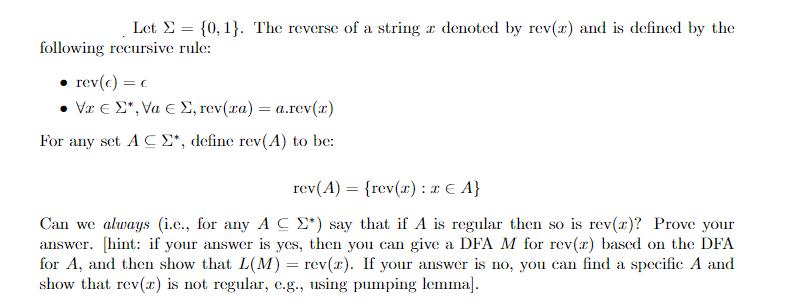
= Let {0,1}. The reverse of a string a denoted by rev(r) and is defined by the following recursive rule: rev(c) = c Vr, Va , rev(xa) = a.rev(x) For any set AC*, define rev(A) to be: rev(A) = {rev(x): 2A} Can we always (i.c., for any AC *) say that if A is regular then so is rev(x)? Prove your answer. [hint: if your answer is yes, then you can give a DFA M for rev(a) based on the DFA for A, and then show that L(M) = rev(x). If your answer is no, you can find a specific A and show that rev(a) is not regular, c.g., using pumping lemma]. = Let {0,1}. The reverse of a string a denoted by rev(r) and is defined by the following recursive rule: rev(c) = c Vr, Va , rev(xa) = a.rev(x) For any set AC*, define rev(A) to be: rev(A) = {rev(x): 2A} Can we always (i.c., for any AC *) say that if A is regular then so is rev(x)? Prove your answer. [hint: if your answer is yes, then you can give a DFA M for rev(a) based on the DFA for A, and then show that L(M) = rev(x). If your answer is no, you can find a specific A and show that rev(a) is not regular, c.g., using pumping lemma].
Step by Step Solution
There are 3 Steps involved in it
Step 1 The answer is yes if A is regular then revA is also regular We can construct a DFA M for revA ... View full answer

Get step-by-step solutions from verified subject matter experts
 Study Help