







Question: Let 0 < P(A) < 1,0 < P(B) < 1 and P(AUB) = P(A) + P(B) P(A) P(B). Then, - (a) P(B A) =
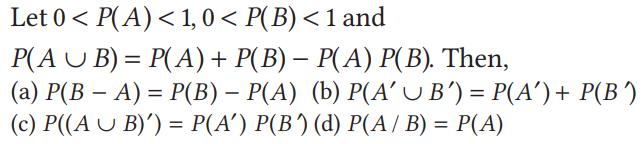
Let 0 < P(A) < 1,0 < P(B) < 1 and P(AUB) = P(A) + P(B) P(A) P(B). Then, - (a) P(B A) = P(B) - P(A) (b) P(A' U B') = P(A') + P(B) (c) P((AUB)') = P(A) P(B^) (d) P(A/B) = P(A)
Step by Step Solution
There are 3 Steps involved in it
1 Expert Approved Answer
Step: 1 Unlock

The detailed ... View full answer
Question Has Been Solved by an Expert!
Get step-by-step solutions from verified subject matter experts
Step: 2 Unlock
Step: 3 Unlock
 Study Help