







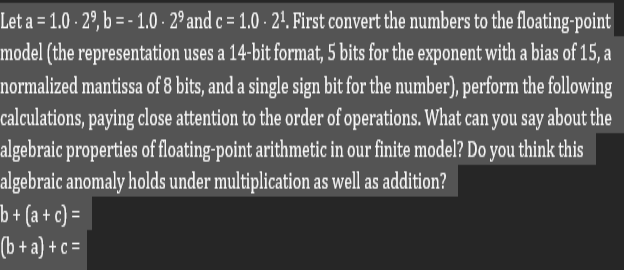
Question: Let a = 1 . 0 * 2 9 , b = - 1 . 0 * 2 9 and c = 1 . 0
Let and First convert the numbers to the floatingpoint
model the representation uses a bit format, bits for the exponent with a bias of a
normalized mantissa of bits, and a single sign bit for the number perform the following
calculations, paying close attention to the order of operations. What can you say about the
algebraic properties of floatingpoint arithmetic in our finite model? Do you think this
algebraic anomaly holds under multiplication as well as addition?
Step by Step Solution
There are 3 Steps involved in it
1 Expert Approved Answer
Step: 1 Unlock

Question Has Been Solved by an Expert!
Get step-by-step solutions from verified subject matter experts
Step: 2 Unlock
Step: 3 Unlock
 Study Help