







Question: Let A = {a, c, e, h, k}, B = {a, b, d, e h, i, k, I}, and C = {a, c, e, i,
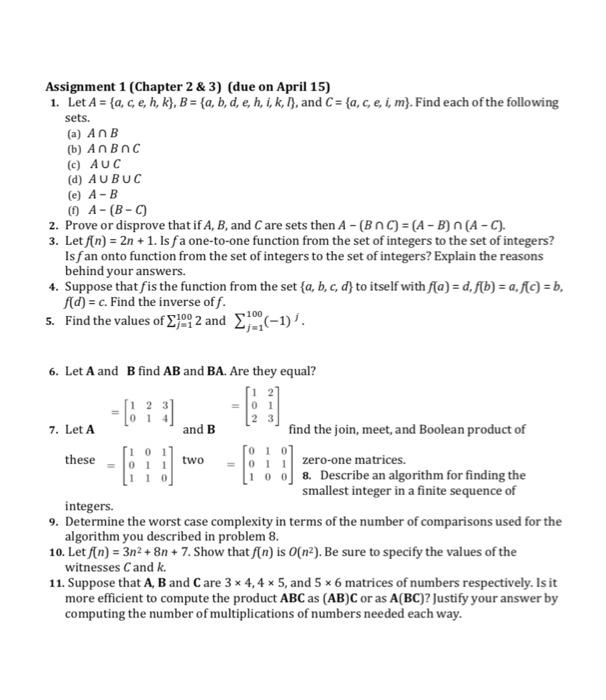
Let A = {a, c, e, h, k}, B = {a, b, d, e h, i, k, I}, and C = {a, c, e, i, m}. Find each of the following sets. (a) A intersection B (b) A intersection B intersection C (c) A union C (d) A union B union C (e) A - B (f) A - (B - C) Prove or disprove that if A, B, and C are sets then A - (B intersection C) = (A - B) intersection (A - C). Let f(n) = 2n + 1.ls f a one-to-one function from the set of integers to the set of integers? Is f an onto function from the set of integers to the set of integers? Explain the reasons behind your answers. Suppose that f is the function from the set {a, b, c, d} to itself with f(a) = d, f(b) = a, f(c) = b, f(d) = c. Find the inverse of f. Find the values of sigma^100_j = 1 2 and sigma^100_j = 1(-1)^j. Let A and B find AB and BA. Are they equal? Let A = [1 0 2 1 3 4] and B = [1 0 2 2 1 3] find the join, meet, and Boolean product of these = [1 0 1 0 1 1 1 1 0] two = [0 0 1 1 1 0 0 1 0] zero-one matrices. Describe an algorithm for finding the smallest integer in a finite sequence of integers. Determine the worst case complexity in terms of the number of comparisons used for the algorithm you described in problem 8. Let f(n) = 3n^2 + 8n + 7. Show that f(n) is O(n^2). Be sure to specify the values of the witnesses C and k. Suppose that A B and C are 3 times 4, 4 times 5, and 5 times 6 matrices of numbers respectively. Is it more efficient to compute the product ABC as (AB)C or as A(BC)? Justify your answer by computing the number of multiplications of numbers needed each way
Step by Step Solution
There are 3 Steps involved in it

Get step-by-step solutions from verified subject matter experts
 Study Help