







Question: Let A= 10 2 3 -1 0 2 1 -21 (a): Estimate the eigenvalues of A using the Gerschgorin's theorem (b): Find the exact eigenvalues
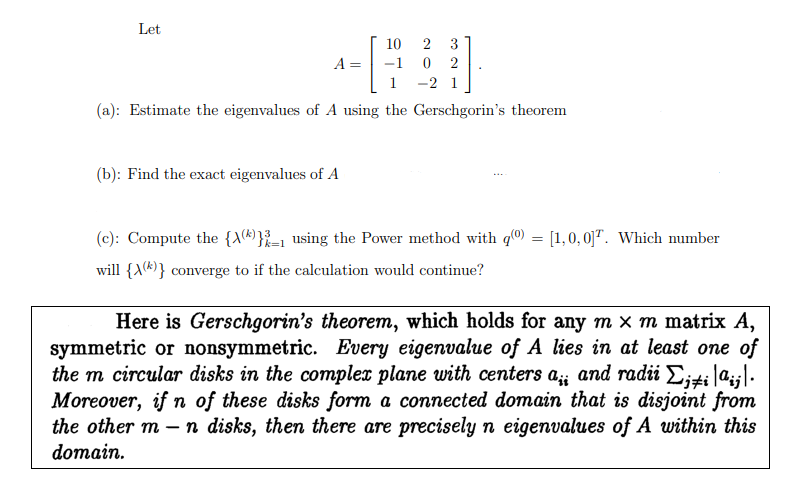
Let A= 10 2 3 -1 0 2 1 -21 (a): Estimate the eigenvalues of A using the Gerschgorin's theorem (b): Find the exact eigenvalues of A (c): Compute the {1(k)}=1 using the Power method with q) = [1,0,0". Which number will {1(k)} converge to if the calculation would continue? Here is Gerschgorin's theorem, which holds for any m x m matrix A, symmetric or nonsymmetric. Every eigenvalue of A lies in at least one of the m circular disks in the complex plane with centers hiji and radii ;tildi;l. Moreover, if n of these disks form a connected domain that is disjoint from the other m -n disks, then there are precisely n eigenvalues of A within this domain. Let A= 10 2 3 -1 0 2 1 -21 (a): Estimate the eigenvalues of A using the Gerschgorin's theorem (b): Find the exact eigenvalues of A (c): Compute the {1(k)}=1 using the Power method with q) = [1,0,0". Which number will {1(k)} converge to if the calculation would continue? Here is Gerschgorin's theorem, which holds for any m x m matrix A, symmetric or nonsymmetric. Every eigenvalue of A lies in at least one of the m circular disks in the complex plane with centers hiji and radii ;tildi;l. Moreover, if n of these disks form a connected domain that is disjoint from the other m -n disks, then there are precisely n eigenvalues of A within this domain
Step by Step Solution
There are 3 Steps involved in it

Get step-by-step solutions from verified subject matter experts
 Study Help