







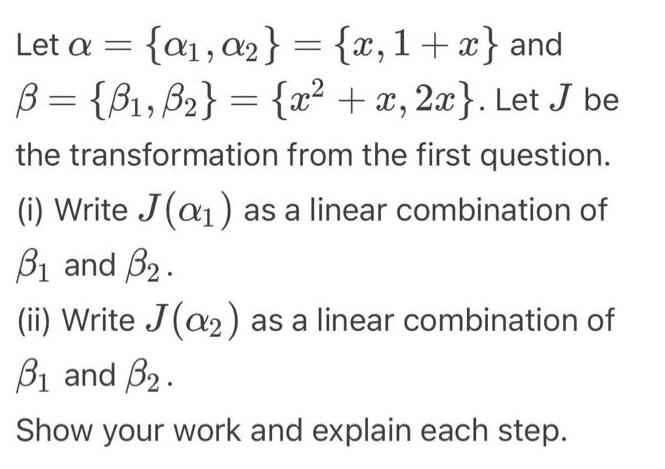
Question: Let a = {a, a2} = {x,1+x} and B = {B, B} = {x + x, 2x}. Let J be the transformation from the
![[ J: P_{1}(mathbb{R}) ightarrow W ] where ( W subseteq P_{2}(mathbb{R}) ) and where ( mathrm{J} ) is the integrat](https://dsd5zvtm8ll6.cloudfront.net/si.experts.images/questions/2023/03/64095f0ec0757_1678335758503.png)
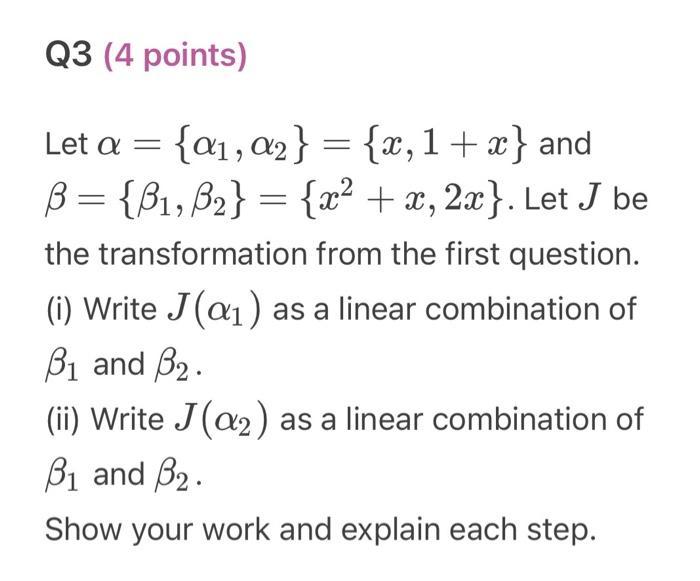
Let a = {a, a2} = {x,1+x} and B = {B, B} = {x + x, 2x}. Let J be the transformation from the first question. (i) Write J(a) as a linear combination of B and . (ii) Write J(a) as a linear combination of B and . Show your work and explain each step. Q1 (2 points) Let J: P (R) W where WC P (R) and where J is the integration operator such that J(p) = [p(x) dx with the constant term of the anti-derivative equal to zero. In other words, J(p) (0) = 0. This is another way of writing J(p) = 0 when x = 0. Write a general formula for J (p) for an arbitrary polynomial p = P (R). Q3 (4 points) Let a = {a, a} = {x,1+x} and B = {B1, B} = {x + x, 2x}. Let J be the transformation from the first question. (i) Write J (a) as a linear combination of B and . (ii) Write J(a) as a linear combination of B and . Show your work and explain each step.
Step by Step Solution
3.51 Rating (154 Votes )
There are 3 Steps involved in it
Let 0 9 2 1re and B P P x x 2x 2 i So J 5x x dx 2 4 P1 2P2 G ... View full answer

Get step-by-step solutions from verified subject matter experts
 Study Help