



Question: Let A and B be n x n matrices. Suppose that A is similar to B, that is, there exists an invertible n x n
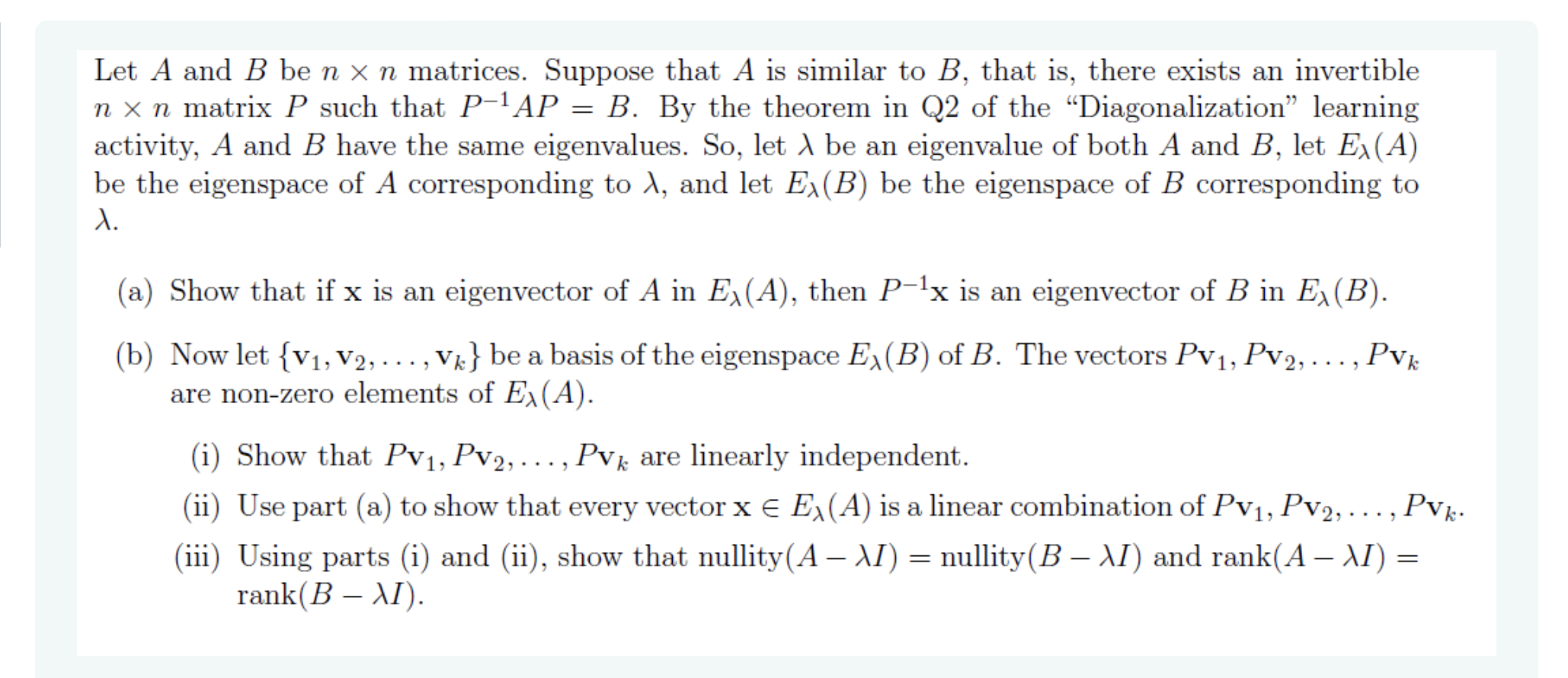
Let A and B be n x n matrices. Suppose that A is similar to B, that is, there exists an invertible n x n matrix P such that P-AP = B. By the theorem in Q2 of the "Diagonalization" learning activity, A and B have the same eigenvalues. So, let A be an eigenvalue of both A and B, let Ex (A) be the eigenspace of A corresponding to 1, and let Ex(B) be the eigenspace of B corresponding to (a) Show that if x is an eigenvector of A in Ex(A), then P-1x is an eigenvector of B in Ex (B). (b) Now let { v1, v2, ..., Vx} be a basis of the eigenspace Ex (B) of B. The vectors Pv1, Pv2, . . ., PVk are non-zero elements of Ex (A). (i) Show that Pv1, Pv2, ..., PVk are linearly independent. (ii) Use part (a) to show that every vector x E Ex (A) is a linear combination of Pv1, Pv2, . . ., PVk. (iii) Using parts (i) and (ii), show that nullity(A - A/) = nullity(B - AI) and rank(A - X/) = rank(B - XI)
Step by Step Solution
There are 3 Steps involved in it

Get step-by-step solutions from verified subject matter experts