





Question: Let a, b, c E C, a = 0, and put h(z) = az + B, fc(z) = z2 + c. Define f=h-lo fcoh. Using
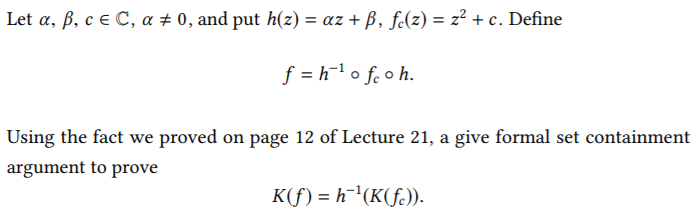
 Let a, b, c E C, a = 0, and put

h(z) = az + B, fc(z) = z2 + c. Define f=h-lo

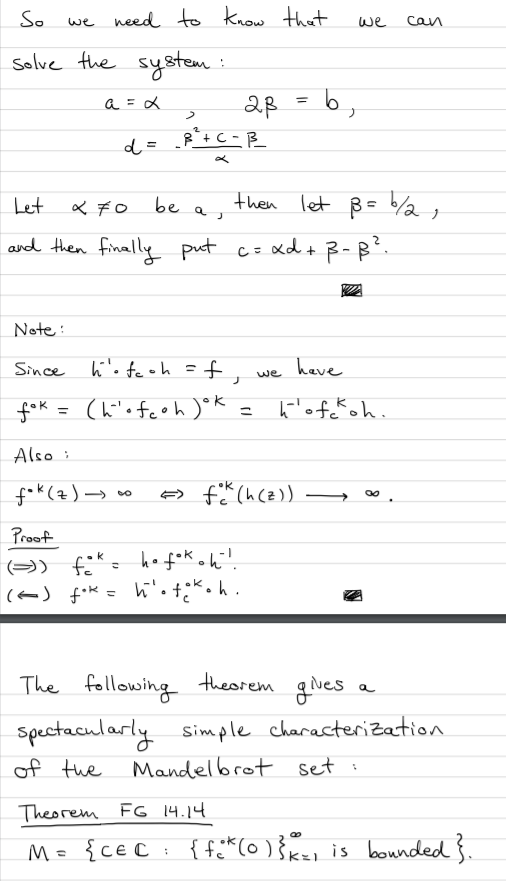
Let a, b, c E C, a = 0, and put h(z) = az + B, fc(z) = z2 + c. Define f=h-lo fcoh. Using the fact we proved on page 12 of Lecture 21, a give formal set containment argument to prove K(f) = h-'(K(f.)). we we can So need to know that solve the system a = x 2B = b, d = B+C-3 > Let fo* hofok.h! (6) fok= h'itik.h. nes a The following theorem gives spectacularly simple characterization of the Mandelbrot set : Theorem FG 14.14 M = {CEC : { fit (o)}Kz, is bounded }, Let a, b, c E C, a = 0, and put h(z) = az + B, fc(z) = z2 + c. Define f=h-lo fcoh. Using the fact we proved on page 12 of Lecture 21, a give formal set containment argument to prove K(f) = h-'(K(f.)). we we can So need to know that solve the system a = x 2B = b, d = B+C-3 > Let fo* hofok.h! (6) fok= h'itik.h. nes a The following theorem gives spectacularly simple characterization of the Mandelbrot set : Theorem FG 14.14 M = {CEC : { fit (o)}Kz, is bounded }

Step by Step Solution

There are 3 Steps involved in it

1 Expert Approved Answer
Step: 1 Unlock blur-text-image
Question Has Been Solved by an Expert!

Get step-by-step solutions from verified subject matter experts

Step: 2 Unlock
Step: 3 Unlock

Students Have Also Explored These Related Accounting Questions!

Q:

\f