







Question: Let A = the event someone tested positive for a virus and B = the event someone has the virus. What is the contextual
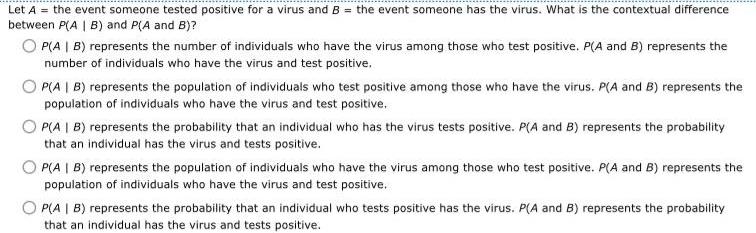
Let A = the event someone tested positive for a virus and B = the event someone has the virus. What is the contextual difference between P(A|B) and P(A and B)? OP(A|B) represents the number of individuals who have the virus among those who test positive. P(A and B) represents the number of individuals who have the virus and test positive. OP(A|B) represents the population of individuals who test positive among those who have the virus. P(A and B) represents the population of individuals who have the virus and test positive. P(A|B) represents the probability that an individual who has the virus tests positive. P(A and B) represents the probability that an individual has the virus and tests positive. P(A|B) represents the population of individuals who have the virus among those who test positive. P(A and B) represents the population of individuals who have the virus and test positive. P(A|B) represents the probability that an individual who tests positive has the virus. P(A and B) represents the probability that an individual has the virus and tests positive.
Step by Step Solution
There are 3 Steps involved in it

Get step-by-step solutions from verified subject matter experts
 Study Help