







Question: Let = {a,b} and consider the language L = {we L* | the number of a's in w is equal to the number of b's
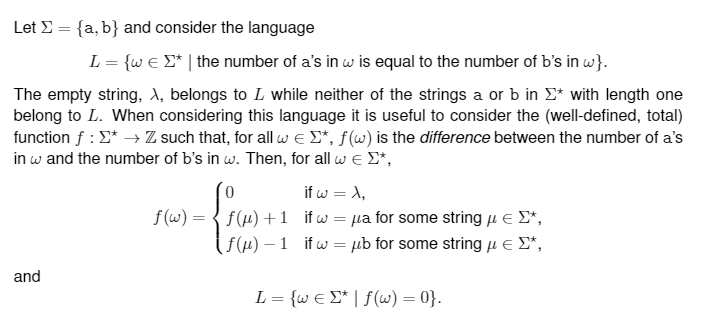

Let = {a,b} and consider the language L = {we L* | the number of a's in w is equal to the number of b's in w}. The empty string, 1, belongs to L while neither of the strings a or b in S* with length one belong to L. When considering this language it is useful to consider the well-defined, total) function f : I* +Z such that, for all we ex, f(w) is the difference between the number of a's in w and the number of b's in w. Then, for all we *, 0 if w=X, f(W) = f(n) +1 ifw = pa for some string pet, if(u) - 1 if w=ub for some string u e*, and L = {we * f(w)=0}. 4. Prove that L CL(G), for the language L CE* defined in this assignment and for the grammar G that you have given when solving the above problem. Let = {a,b} and consider the language L = {we L* | the number of a's in w is equal to the number of b's in w}. The empty string, 1, belongs to L while neither of the strings a or b in S* with length one belong to L. When considering this language it is useful to consider the well-defined, total) function f : I* +Z such that, for all we ex, f(w) is the difference between the number of a's in w and the number of b's in w. Then, for all we *, 0 if w=X, f(W) = f(n) +1 ifw = pa for some string pet, if(u) - 1 if w=ub for some string u e*, and L = {we * f(w)=0}. 4. Prove that L CL(G), for the language L CE* defined in this assignment and for the grammar G that you have given when solving the above
Step by Step Solution
There are 3 Steps involved in it

Get step-by-step solutions from verified subject matter experts
 Study Help