







Question: Let (, , ) be a predicate that represents the statement makes a fool of on day . Thus, for example, : : (, ,
Let (, , ) be a predicate that represents the statement makes a fool of on day . Thus, for example, : : (, , ) means that there is someone who fools Lem every day
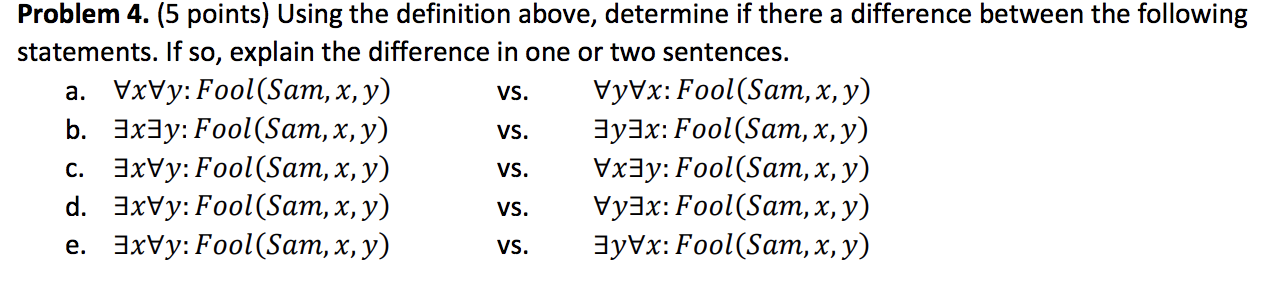
Problem 4. (5 points) Using the definition above, determine if there a difference between the following statements. If so, explain the difference in one or two sentences. a. VxVy: Fool(Sam, x, y) vs. VyVx: Fool(Sam, x, y) b. 3x3y: Fool(Sam, x, y) vs. Syx: Fool(Sam, x,y) C. 3xVy: Fool(Sam, x, y) Vx3y: Fool(Sam, x, y) d. 3xVy: Fool(Sam, x, y) Vy3x: Fool(Sam, x, y) e. 3xVy: Fool(Sam, x, y) 3yVx: Fool(Sam, x, y) vs. Vs. vs. Problem 4. (5 points) Using the definition above, determine if there a difference between the following statements. If so, explain the difference in one or two sentences. a. VxVy: Fool(Sam, x, y) vs. VyVx: Fool(Sam, x, y) b. 3x3y: Fool(Sam, x, y) vs. Syx: Fool(Sam, x,y) C. 3xVy: Fool(Sam, x, y) Vx3y: Fool(Sam, x, y) d. 3xVy: Fool(Sam, x, y) Vy3x: Fool(Sam, x, y) e. 3xVy: Fool(Sam, x, y) 3yVx: Fool(Sam, x, y) vs. Vs. vs
Step by Step Solution
There are 3 Steps involved in it

Get step-by-step solutions from verified subject matter experts
 Study Help