







Question: Problem 1. (10 points) Let Fool(x, y,d) be a predicate that represents the statement x makes a fool of y on day d. Thus, for
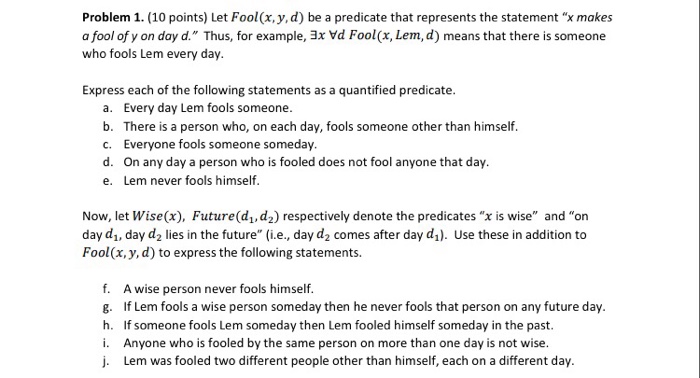
Problem 1. (10 points) Let Fool(x, y,d) be a predicate that represents the statement "x makes a fool of y on day d." Thus, for example, 3x Vd Fool(x, Lem, d) means that there is someone who fools Lem every day. Express each of the following statements as a quantified predicate. a. b. c. d. e. Every day Lem fools someone. There is a person who, on each day, fools someone other than himself. Everyone fools someone someday. On any day a person who is fooled does not fool anyone that day. Lem never fools himself. Now, let Wise(x), Future(d1,d2) respectively denote the predicates "x is wise" and "on day di, day d2 lies in the future" (i.e., day d2 comes after day di). Use these in addition to Fool(x, y, d) to express the following statements. t. A wise person never fools himself. g. If Lem fools a wise person someday then he never fools that person on any future day. h. If someone fools Lem someday then Lem fooled himself someday in the past. i. Anyone who is fooled by the same person on more than one day is not wise. j. Lem was fooled two different people other than himself, each on a different day
Step by Step Solution
There are 3 Steps involved in it

Get step-by-step solutions from verified subject matter experts
 Study Help