



Question: Let {B_(t)}_(t)>=0 be Brownian motion started at 0 and F_(t)^(B)=sigma ({B_(s):0 . Are the following x_(t)(F_(t)^(B)) -martingale? (Explain the reason as well.) x_(t):=B_(t)^(2)-t x_(t):=t^(2)B_(t)-int_0^t
Let
{B_(t)}_(t)>=0be Brownian motion started at 0 and
F_(t)^(B)=\\\\sigma ({B_(s):0. Are the\ following
x_(t)(F_(t)^(B))-martingale? (Explain the reason as well.)\
x_(t):=B_(t)^(2)-t\
x_(t):=t^(2)B_(t)-\\\\int_0^t sB_(s)ds\
x_(t):=e^(B_(t)-(t)/(2))\
{x_(t)}_(t)>=0 is called the It process if there exist
\\\\sigma inL^(2) and
\\\\mu inL^(1) such that\
x_(t)(\\\\omega )=x_(0)(\\\\omega )+\\\\int_0^t \\\\sigma (s,\\\\omega )dB_(s)(\\\\omega )+\\\\int_0^t \\\\mu (s,\\\\omega )ds,t>=0.\ Here
{B_(t)(\\\\omega )}_(t)>=0 is
(F_(t))-Brownian motion.
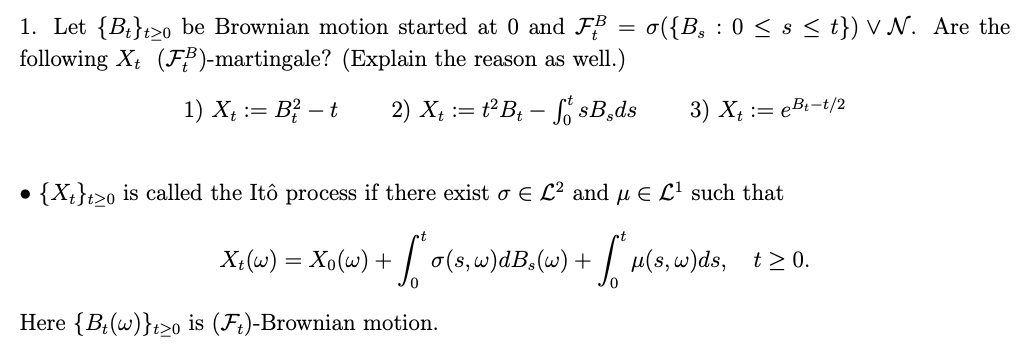
1. Let {Bt}t0 be Brownian motion started at 0 and FtB=({Bs:0st})N. Are the following Xt(FtB)-martingale? (Explain the reason as well.) 1) Xt:=Bt2t 2) Xt:=t2Bt0tsBsds 3) Xt:=eBtt/2 - {Xt}t0 is called the It process if there exist L2 and L1 such that Xt()=X0()+0t(s,)dBs()+0t(s,)ds,t0. Here {Bt()}t0 is (Ft)-Brownian motion
Step by Step Solution
There are 3 Steps involved in it
1 Expert Approved Answer
Step: 1 Unlock

Question Has Been Solved by an Expert!
Get step-by-step solutions from verified subject matter experts
Step: 2 Unlock
Step: 3 Unlock