







Question: Let f be a continuous function such that f changes from increasing to decreasing, and the graph of f changes from concave up to concave
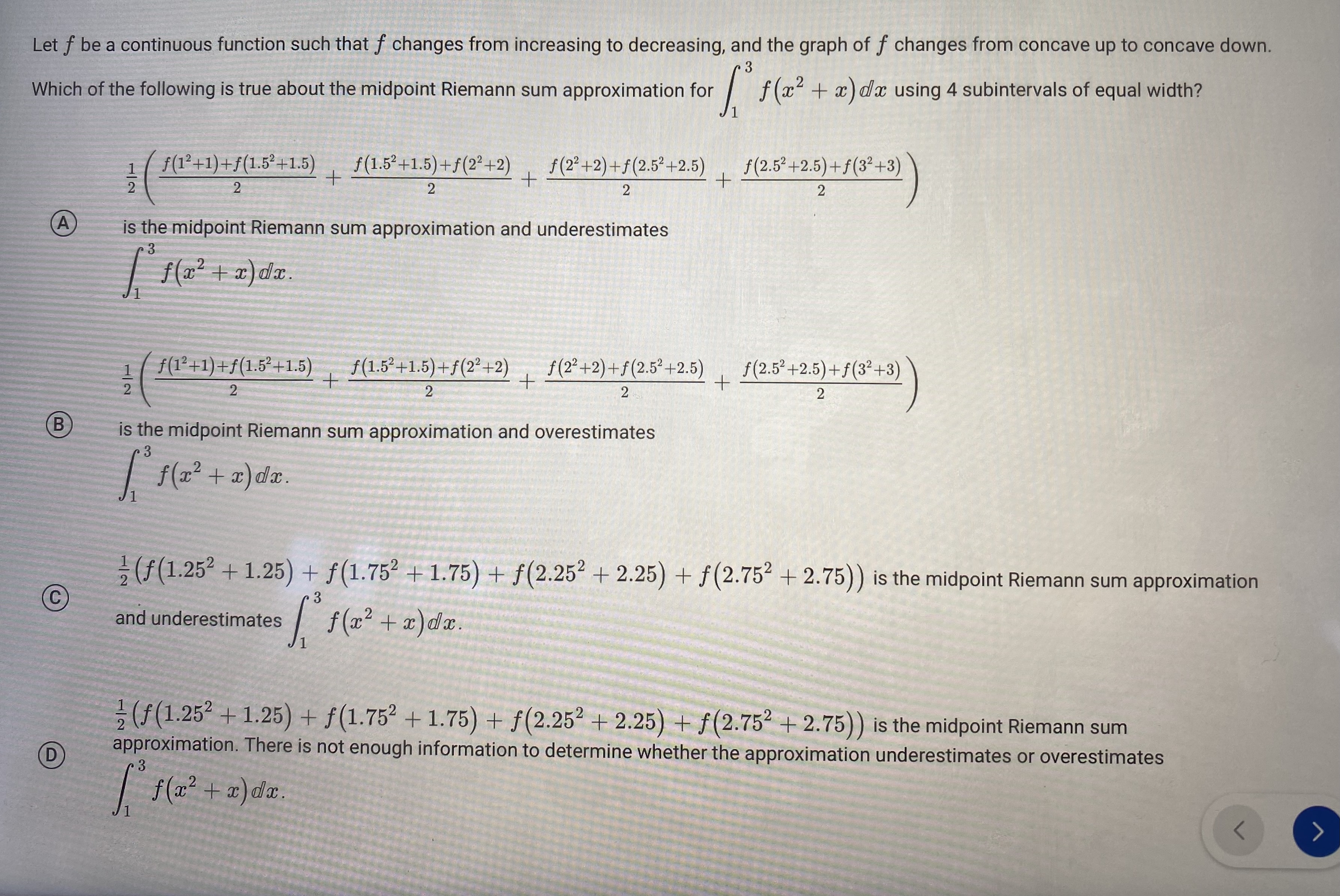
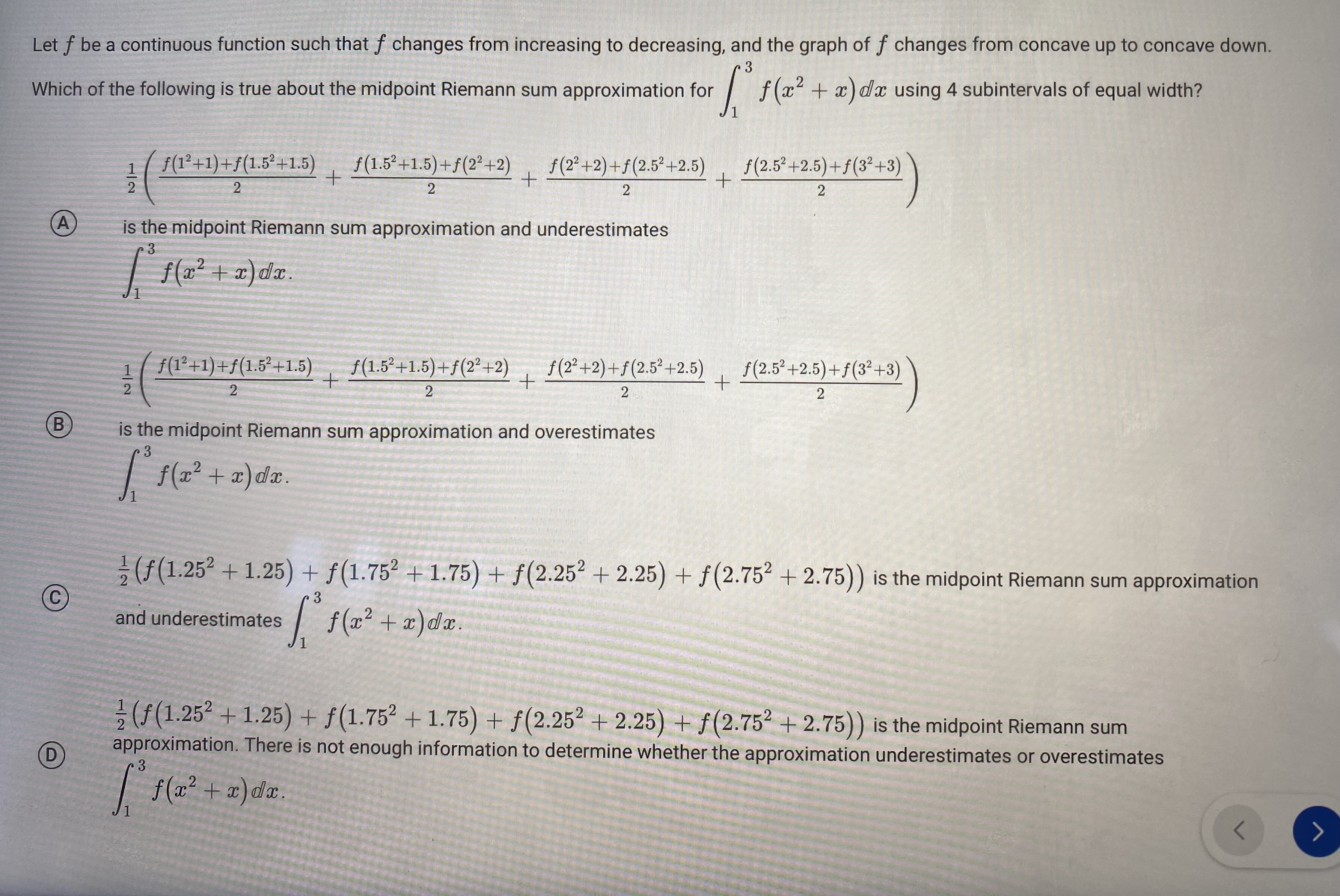
Let f be a continuous function such that f changes from increasing to decreasing, and the graph of f changes from concave up to concave down. Which of the following is true about the midpoint Riemann sum approximation for / f (x2 + ac ) dac using 4 subintervals of equal width? f (12 +1) + f (1.52+ 1.5) + f (1.5 +1.5) + f(22 + 2) f ( 2 2 + 2 ) + f ( 2.52 + 2.5 ) f(2.5' + 2.5) +f(32+3) 2 2 2 2 A is the midpoint Riemann sum approximation and underestimates f (12 + 1) + f (1.52 + 1.5) f (1.52+ 1.5) +f (22 + 2 ) 1 f(22 + 2 ) + f ( 2.52 + 2.5 ) f(2.5' + 2.5) +f(32+3) 2 2 2 + B is the midpoint Riemann sum approximation and overestimates f ( 2 2 + 2 ) do . C (f (1.252 + 1.25) + f ( 1. 752 + 1.75) + f( 2.252 + 2.25) + f( 2.752 + 2.75) ) is the midpoint Riemann sum approximation and underestimates / f(x2 + x) dx. (f(1.252 + 1.25) + f(1.752 + 1.75) + f( 2.252 + 2.25) + f( 2.752 + 2.75)) is the midpoint Riemann sum (D approximation. There is not enough information to determine whether the approximation underestimates or overestimates <
Step by Step Solution
There are 3 Steps involved in it

Get step-by-step solutions from verified subject matter experts
 Study Help