







Question: Let F be a (length-preserving) pseudorandom function and G a pseudorandom generator with expansion factor l(n)=n +1. For each of the following encryption schemes, state
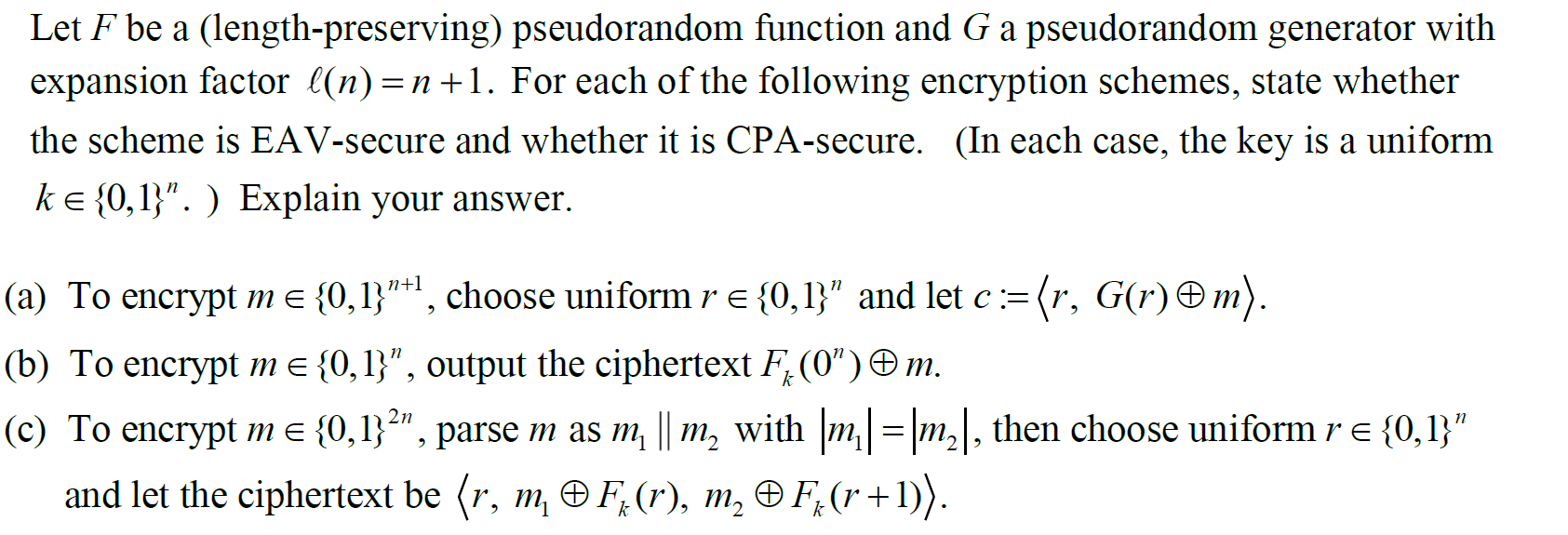
Let F be a (length-preserving) pseudorandom function and G a pseudorandom generator with expansion factor l(n)=n +1. For each of the following encryption schemes, state whether the scheme is EAV-secure and whether it is CPA-secure. (In each case, the key is a uniform ke{0,1}. ) Explain your answer. (a) To encrypt m {0,1}"+l, choose uniform r e {0,1}" and let c:=(r, G(r) m). (b) To encrypt m e{0,1}", output the ciphertext Fx (0) Om. (C) To encrypt m {0,1}?", parse m as m || m, with [m] =\m2), then choose uniform r e {0,1}" and let the ciphertext be (r, m, F/(r), m, F(r +1)). Let F be a (length-preserving) pseudorandom function and G a pseudorandom generator with expansion factor l(n)=n +1. For each of the following encryption schemes, state whether the scheme is EAV-secure and whether it is CPA-secure. (In each case, the key is a uniform ke{0,1}. ) Explain your answer. (a) To encrypt m {0,1}"+l, choose uniform r e {0,1}" and let c:=(r, G(r) m). (b) To encrypt m e{0,1}", output the ciphertext Fx (0) Om. (C) To encrypt m {0,1}?", parse m as m || m, with [m] =\m2), then choose uniform r e {0,1}" and let the ciphertext be (r, m, F/(r), m, F(r +1))
Step by Step Solution
There are 3 Steps involved in it

Get step-by-step solutions from verified subject matter experts
 Study Help