







Question: Let f(x) = 2x + 6, X1 = 1, X2 = 2, X3 = 3, X4 = 4, and Ax = 1. (a) Find _
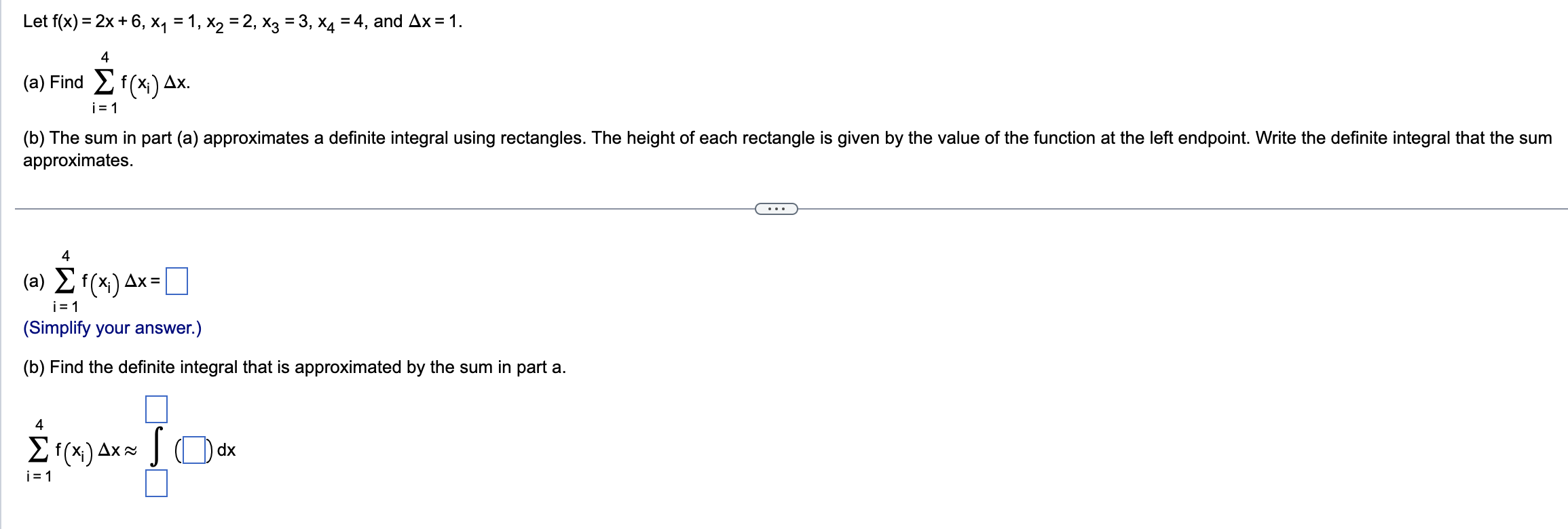
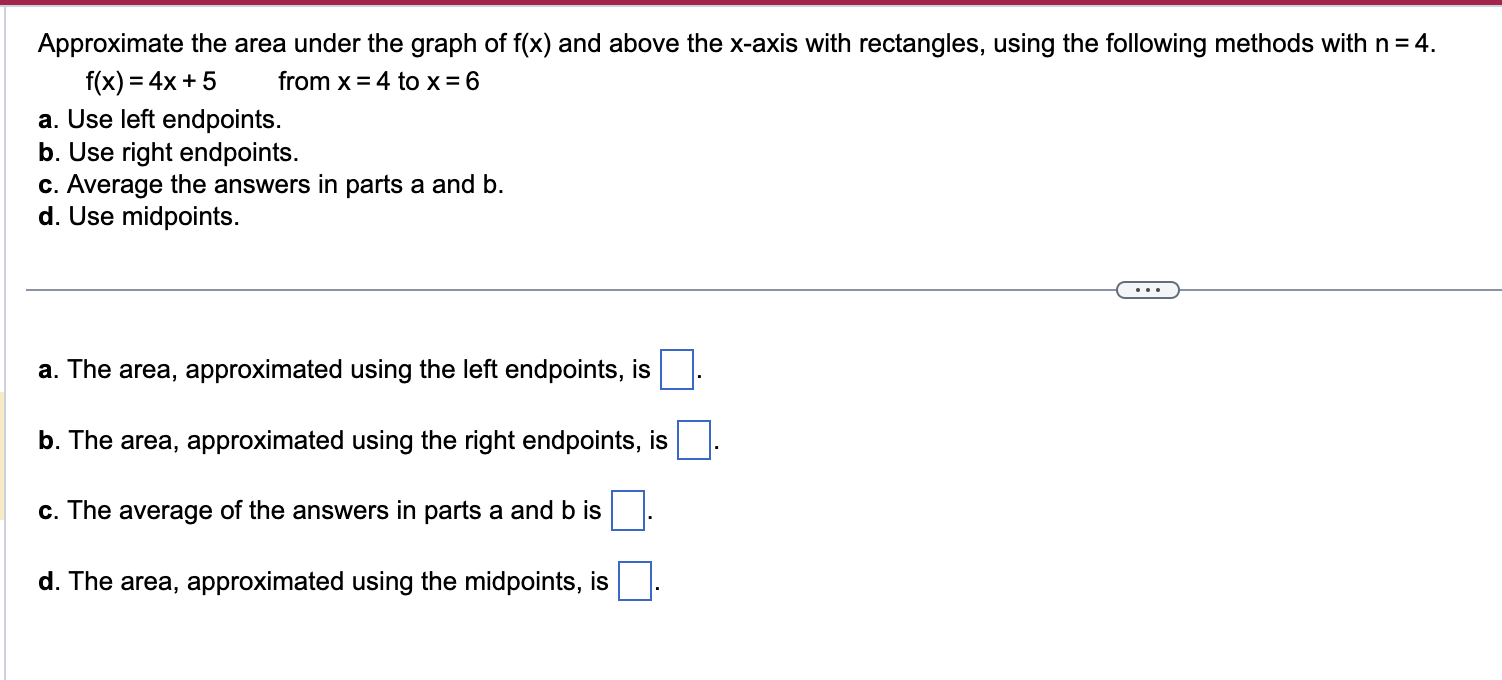
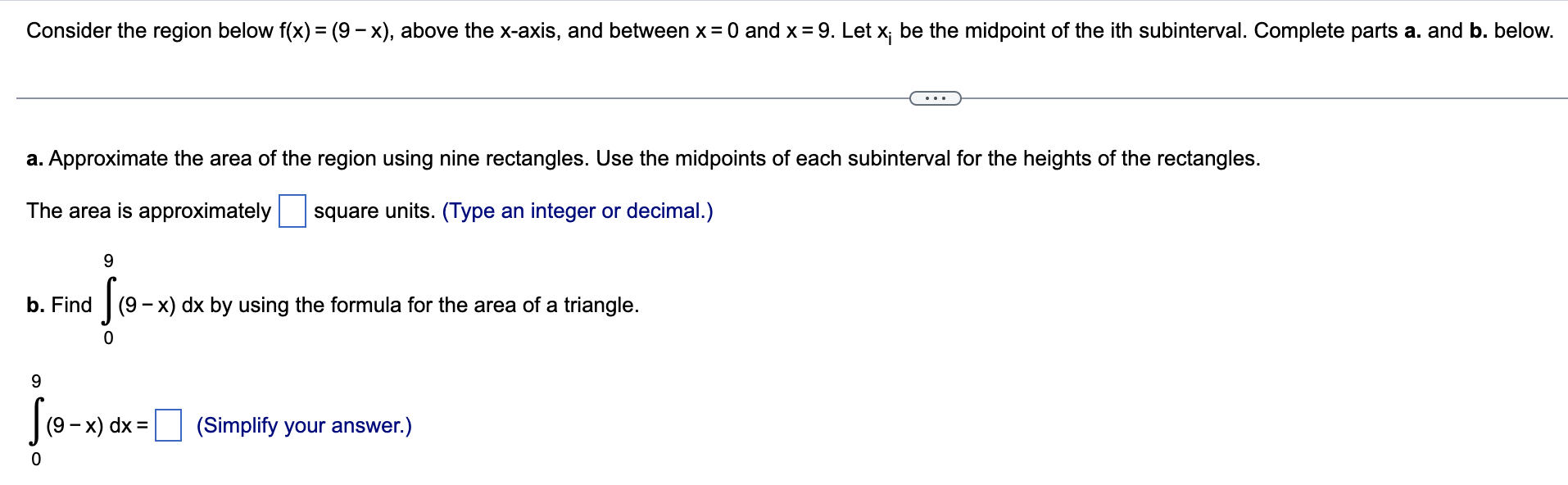
Let f(x) = 2x + 6, X1 = 1, X2 = 2, X3 = 3, X4 = 4, and Ax = 1. (a) Find _ f (x; ) Ax. i = 1 (b) The sum in part (a) approximates a definite integral using rectangles. The height of each rectangle is given by the value of the function at the left endpoint. Write the definite integral that the sum approximates. (a) Ef (x; ) Ax = [ i = 1 (Simplify your answer.) (b) Find the definite integral that is approximated by the sum in part a. Ef ( x,) Ax= ) () dx i= 1Approximate the area under the graph of f(x) and above the x-axis with rectangles, using the following methods with n = 4. f(X) = 4x + 5 from x = 4 to x = 6 a. Use left endpoints. b. Use right endpoints. c. Average the answers in parts a and b. d. Use midpoints. . . . a. The area, approximated using the left endpoints, is b. The area, approximated using the right endpoints, is c. The average of the answers in parts a and b is d. The area, approximated using the midpoints, isConsider the region below f(x) = (9 - x), above the xaxis, and between x = 0 and x = 9. Let xi be the midpoint of the ith subinterval. Complete parts a. and b. below. (E a. Approximate the area of the region using nine rectangles. Use the midpoints of each subinterval for the heights of the rectangles. The area is approximately D square units. (Type an integer or decimal.) 9 b. Find I\") - x) dx by using the formula for the area of a triangle. 0 9 J-(Q - x) dx = D (Simplify your answer.) 0
Step by Step Solution
There are 3 Steps involved in it

Get step-by-step solutions from verified subject matter experts
 Study Help