







Question: Let G be a graph that represents a computer network, and let b(e) be the bottleneck of edge e assume all edges have distinct, positive
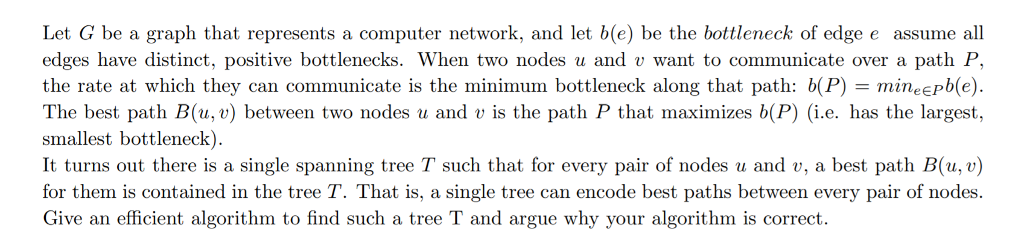
Let G be a graph that represents a computer network, and let b(e) be the bottleneck of edge e assume all edges have distinct, positive bottlenecks. When two nodes u and v want to communicate over a path P, the rate at which they can communicate is the minimum bottleneck along that path: b(P)mineepb(e). The best path B(u, v) between two nodes u and v is the path P that maximizes b(P) (ie. has the largest, smallest bottleneck) It turns out there is a single spanning tree T such that for every pair of nodes u and v, a best path B(u, v) for them is contained in the tree T. That is, a single tree can encode best paths between every pair of nodes. Give an efficient algorithm to find such a tree T and argue why your algorithm is correct
Step by Step Solution
There are 3 Steps involved in it

Get step-by-step solutions from verified subject matter experts
 Study Help