







Question: Let G = (V, E) be an undirected graph where |V| = n and |E| = m. Suppose for two vertices u, v Element G,
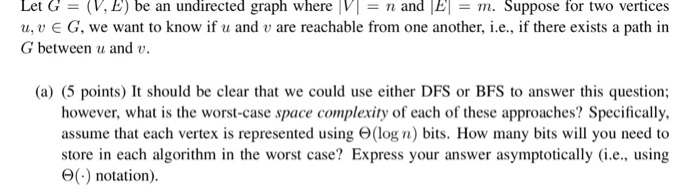
Let G = (V, E) be an undirected graph where |V| = n and |E| = m. Suppose for two vertices u, v Element G, we want to know if u and v are reachable from one another, i.e., if there exists a path in G between u and v. (a) It should be clear that we could use either DFS or BFS to answer this question however, what is the worst-case space complexity of each of these approaches? Specifically, assume that each vertex is represented using theta (log n) bits. How many bits will you need to store in each algorithm in the worst case? Express your answer asymptotically (i e., using Theta (middot) notation)
Step by Step Solution
There are 3 Steps involved in it
1 Expert Approved Answer
Step: 1 Unlock

Question Has Been Solved by an Expert!
Get step-by-step solutions from verified subject matter experts
Step: 2 Unlock
Step: 3 Unlock
 Study Help