







Question: Let G=(V, E), V = n, E = m be an undirected graph with nonnegative edge weights. Our discussion of Floyd's algorithm in class showed
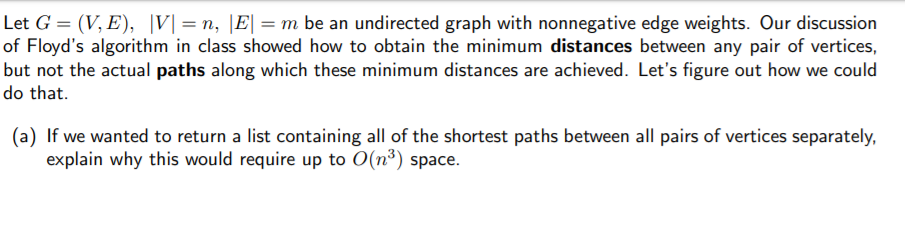
Let G=(V, E), V = n, E = m be an undirected graph with nonnegative edge weights. Our discussion of Floyd's algorithm in class showed how to obtain the minimum distances between any pair of vertices, but not the actual paths along which these minimum distances are achieved. Let's figure out how we could do that. (a) If we wanted to return a list containing all of the shortest paths between all pairs of vertices separately, explain why this would require up to O(n) space. Let G=(V, E), V = n, E = m be an undirected graph with nonnegative edge weights. Our discussion of Floyd's algorithm in class showed how to obtain the minimum distances between any pair of vertices, but not the actual paths along which these minimum distances are achieved. Let's figure out how we could do that. (a) If we wanted to return a list containing all of the shortest paths between all pairs of vertices separately, explain why this would require up to O(n) space
Step by Step Solution
There are 3 Steps involved in it

Get step-by-step solutions from verified subject matter experts
 Study Help