







Question: Let i be a random variable with the following discrete distribution: i is 5% with probability 21, 10% with probability 41 and 4% with probability
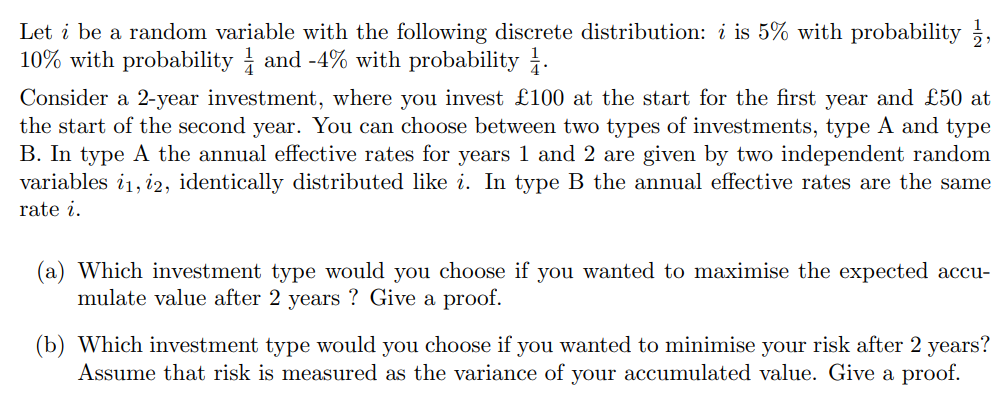
Let i be a random variable with the following discrete distribution: i is 5% with probability 21, 10% with probability 41 and 4% with probability 41. Consider a 2-year investment, where you invest 100 at the start for the first year and 50 at the start of the second year. You can choose between two types of investments, type A and type B. In type A the annual effective rates for years 1 and 2 are given by two independent random variables i1,i2, identically distributed like i. In type B the annual effective rates are the same rate i. (a) Which investment type would you choose if you wanted to maximise the expected accumulate value after 2 years ? Give a proof. (b) Which investment type would you choose if you wanted to minimise your risk after 2 years? Assume that risk is measured as the variance of your accumulated value. Give a proof
Step by Step Solution
There are 3 Steps involved in it

Get step-by-step solutions from verified subject matter experts
 Study Help