







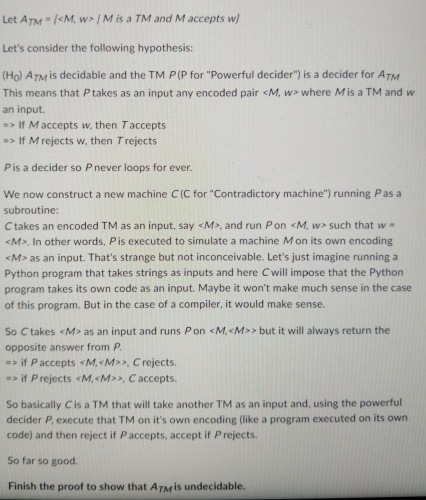
Question: Let is a T M and M accepts { : w } Let's consider the following hypothesis: ( H 0 ) A T M is
Let is a and accepts :
Let's consider the following hypothesis:
is decidable and the TM for "Powerful decider" is a decider for This means that takes as an input any encoded pair where is a TM and an input.
If accepts then accepts
If rejects then rejects
is a decider so never loops for ever.
We now construct a new machine for "Contradictory machine" running as a subroutine:
takes an encoded as an input, say and run on such that other words, executed simulate a machine its own encoding input. That's strange but not inconceivable. Let's just imagine running a Python program that takes strings inputs and here will impose that the Python program takes its own code input. Maybe won't make much sense the case this program. But the case a compiler, would make sense.
takes input and runs but will always return the opposite answer from
accepts rejects.
rejects accepts.
basically that will take another input and, using the powerful decider execute that it's own encoding a program executed its own code and then reject accepts, accept rejects.
far good.
Finish the proof show that undecidable.
Step by Step Solution
There are 3 Steps involved in it
1 Expert Approved Answer
Step: 1 Unlock

Question Has Been Solved by an Expert!
Get step-by-step solutions from verified subject matter experts
Step: 2 Unlock
Step: 3 Unlock
 Study Help