







Question: Let L be the language over {a,b,c} accepting all strings so that: 1. All a's occur after the first c. 2. All b's occur before
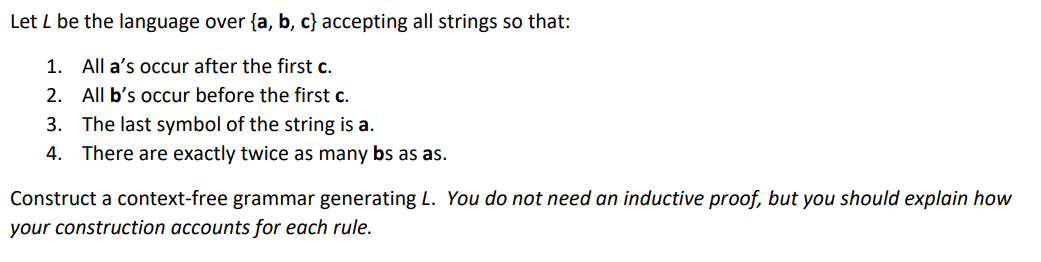
Let L be the language over {a,b,c} accepting all strings so that: 1. All a's occur after the first c. 2. All b's occur before the first c. 3. The last symbol of the string is a. 4. There are exactly twice as many bs as as. Construct a context-free grammar generating L. You do not need an inductive proof, but you should explain how your construction accounts for each rule
Step by Step Solution
There are 3 Steps involved in it
1 Expert Approved Answer
Step: 1 Unlock

Question Has Been Solved by an Expert!
Get step-by-step solutions from verified subject matter experts
Step: 2 Unlock
Step: 3 Unlock
 Study Help