







Question: Questions 1. A set S contains n elements. How many possible subsets can be formed from S (including S and the empty set o)? (Hint:
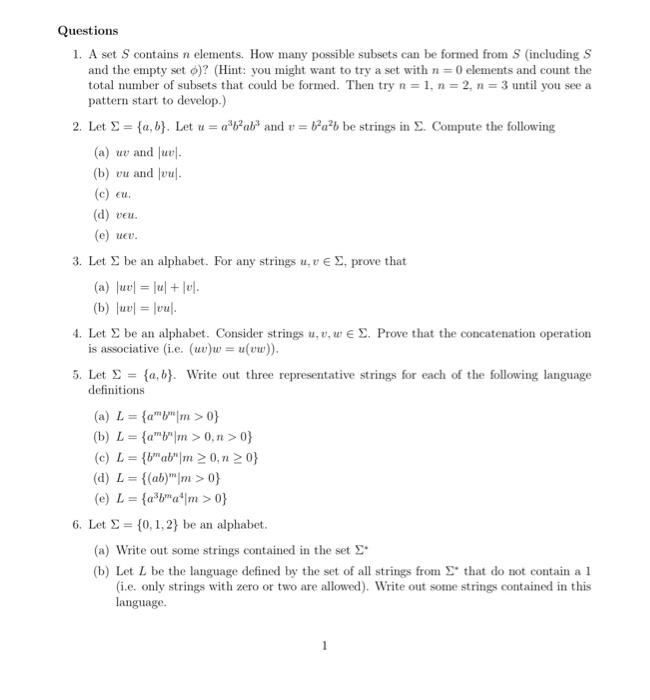
Questions 1. A set S contains n elements. How many possible subsets can be formed from S (including S and the empty set o)? (Hint: you might want to try a set with n=0 elements and count the total number of subsets that could be formed. Then try n=1, n=2, n = 3 until you see a pattern start to develop.) 2. Let S = {a,b}. Let u = ebab and = ba be strings in S. Compute the following (a) w and luvl. (b) vu and ul. (c) eu. (d) veu. (e) we. 3. Let S be an alphabet. For any strings u. v E , prove that (a) uvl = lul + lul. (b) luv = vul 4. Let be an alphabet. Consider strings uw D. Prove that the concatenation operation is associative (i.e. (uw)w = u(vw)). 5. Let S = {a,b). Write out three representative strings for each of the following language definitions (a) L = {4"}}}|m>0} (b) L = {a")"m > 0,n>0} (c) L = {bab"m > 0.n>0} (d) L= {(ab)"\m >0} (e) L = {alma* m>0} 6. Let S = {0,1,2} be an alphabet. (a) Write out some strings contained in the set (b) Let L be the language defined by the set of all strings from that do not contain a 1 (i.e. only strings with zero or two are allowed). Write out some strings contained in this language
Step by Step Solution
There are 3 Steps involved in it

Get step-by-step solutions from verified subject matter experts
 Study Help