







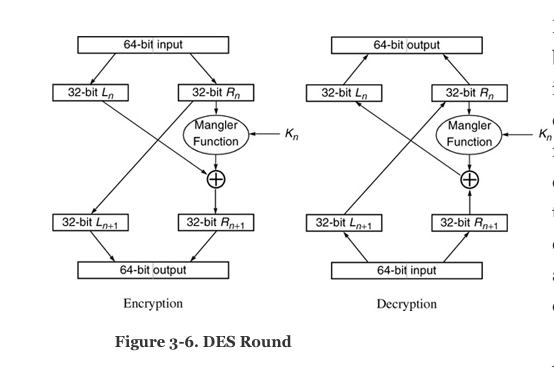
Question: Let Ln, Rn, Kn denote 32-bit, 32-bit and 48-bit random numbers respectively, and let Re(Ln, Rn,Kn) = (Ln+1, Rn+1) represent the DES encryption round shown
-
Let Ln, Rn, Kn denote 32-bit, 32-bit and 48-bit random numbers respectively, and let Re(Ln, Rn,Kn) = (Ln+1, Rn+1) represent the DES encryption round shown in the left diagram in Figure 3.6 in the textbook, which has included 2 functional mappings:
-
LnRnKn Ln+1 (this means Ln+1 is a function of Ln, Rn, Kn)
-
LnRnKn Rn+1 (this means Rn+1 is a function of Ln, Rn, Kn)
-
Prove that Re(Rn+1, Ln+1, Kn) = (Rn, Ln)
64-bit input 64-bit output 32-bit L 32-bit Ly 32-bit Rn 32-bit _, _32-bit R Mangler Function Mangler Function K 32-bit loud 32-bit An:1 32-bit L:1) 32-bit Anti 64-bit output 64-bit input Encryption Decryption Figure 3-6. DES Round
Step by Step Solution
There are 3 Steps involved in it

Get step-by-step solutions from verified subject matter experts
 Study Help