



Question: Let 'M' denote the hash table size. Consider the following four different hash table implementations: a. Implementation (I) uses chaining, and the hash function is
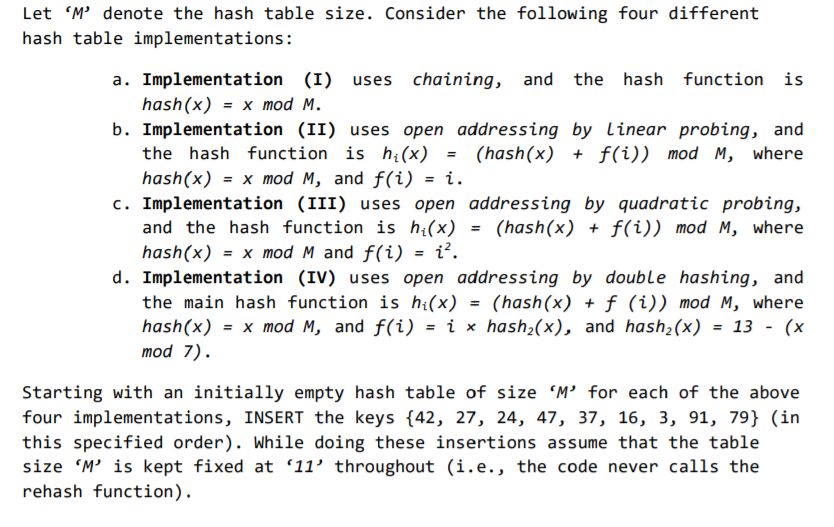
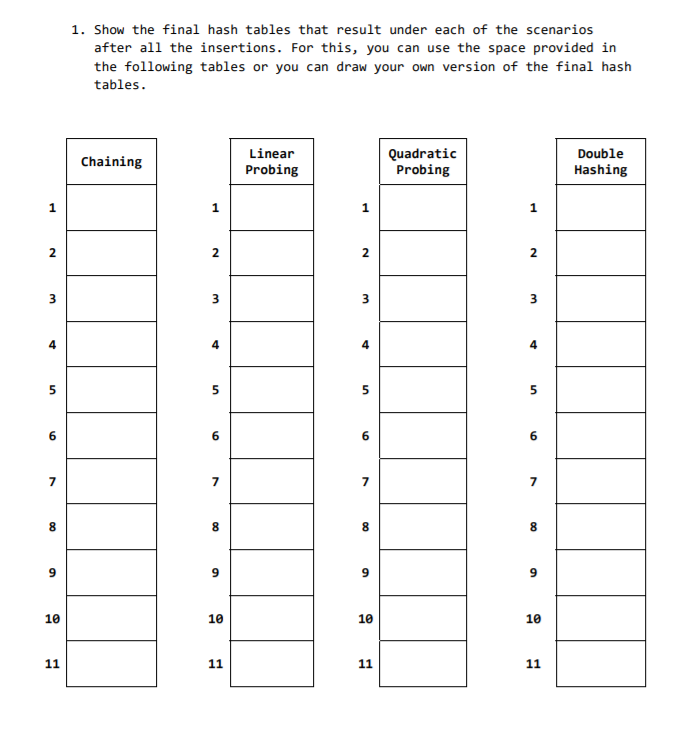
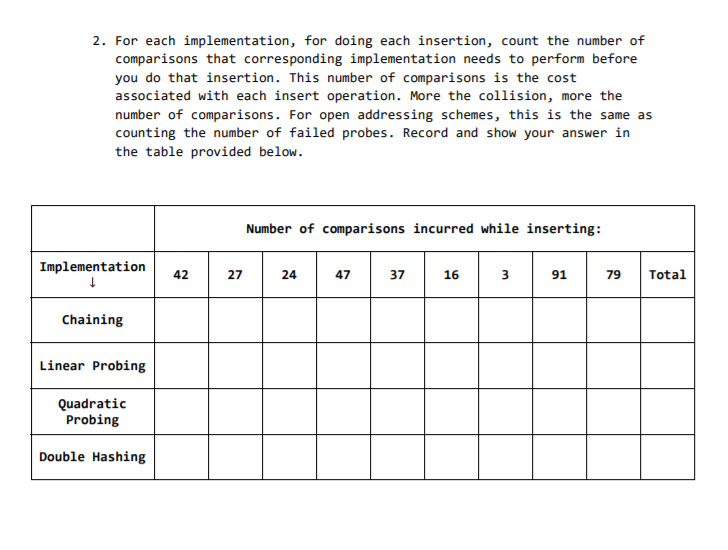
Let 'M' denote the hash table size. Consider the following four different hash table implementations: a. Implementation (I) uses chaining, and the hash function is hash(x)x mod M b. Implementation (II) uses open addressing by Linear probing, and the hash function is hi(x) = (hash(x) + f(i)) mod M, where hash(x) x mod M, and f(i)- c. Implementation (III) uses open addressing by quadratic probing, and the hash function is hx) (hash(x) + f(i)) mod M, where hash(x) -x mod M and f(i)-i. d. Implementation (IV) uses open addressing by double hashing, and the main hash function is hi(x) -(hash(x) + f (i)) mod M, where hash(X) = x mod M, and f(i) = x hash(x), and hash,(x) = 13- (x mod 7) Starting with an initially empty hash table of size 'M' for each of the above four implementations, INSERT the keys {42, 27, 24, 47, 37, 16, 3, 91, 79} (irn this specified order). While doing these insertions assume that the table size 'M' is kept fixed at '11' throughout (i.e., the code never calls the rehash function)
Step by Step Solution
There are 3 Steps involved in it

Get step-by-step solutions from verified subject matter experts