







Question: Let M = {(x, y) = R x R: x + y r}, where r > 0. Consider the geometric progression 1 an n
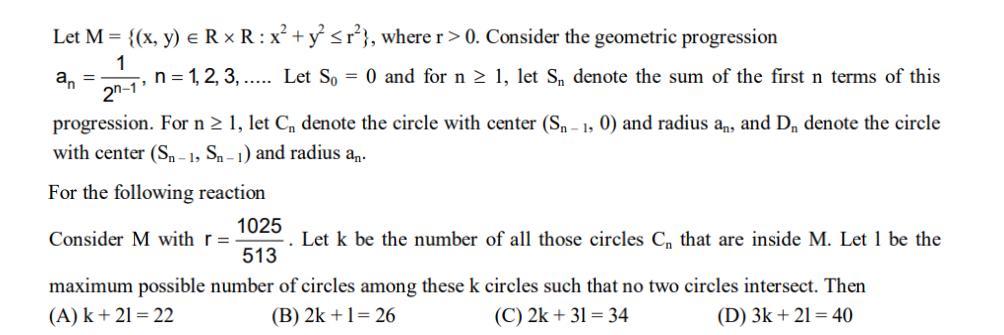
Let M = {(x, y) = R x R: x + y r}, where r > 0. Consider the geometric progression 1 an n = 1, 2, 3, ..... Let So = 0 and for n 1, let S, denote the sum of the first n terms of this 27-1 progression. For n 1, let C denote the circle with center (Sn-1, 0) and radius an, and D, denote the circle with center (Sn-1, Sn-1) and radius an. For the following reaction Consider M with r = 1025 513 Let k be the number of all those circles C that are inside M. Let 1 be the maximum possible number of circles among these k circles such that no two circles intersect. Then (A) k +21=22 (B) 2k+1=26 (D) 3k +21=40 (C) 2k +31 = 34
Step by Step Solution
3.43 Rating (159 Votes )
There are 3 Steps involved in it
The detailed ... View full answer

Get step-by-step solutions from verified subject matter experts
 Study Help