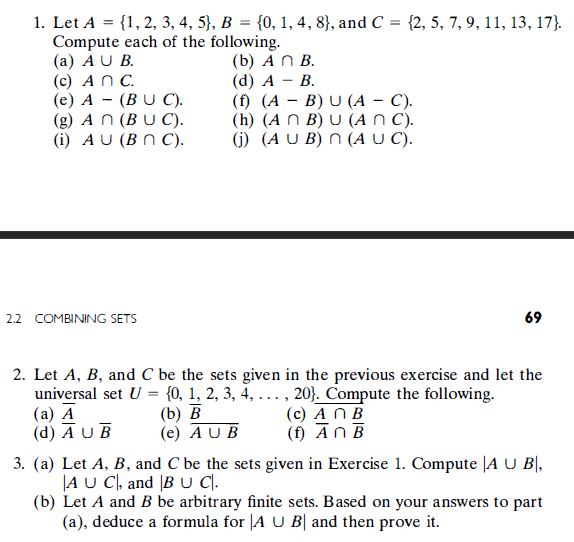
Question: 1. Let A = {1, 2, 3, 4, 5), B = {0, 1, 4, 8}, and C = {2, 5, 7, 9, 1 1, 13,
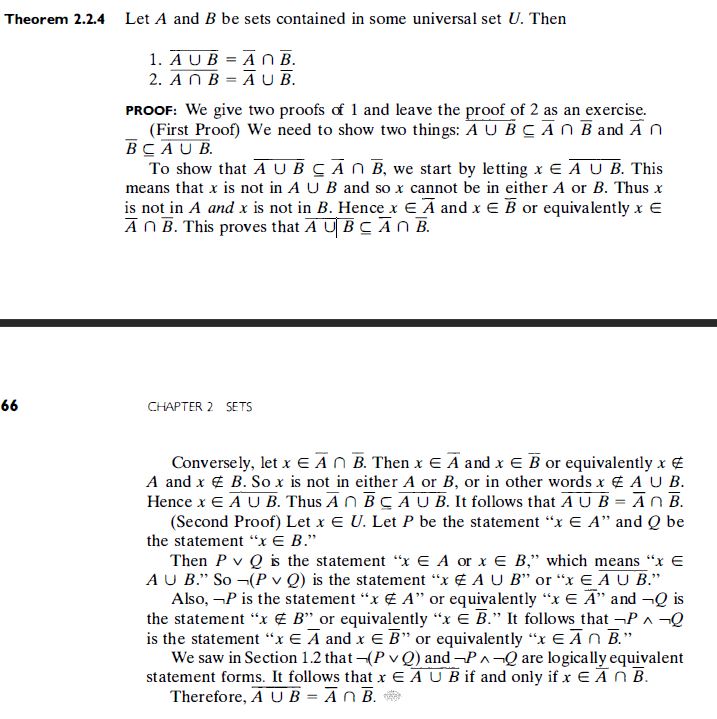
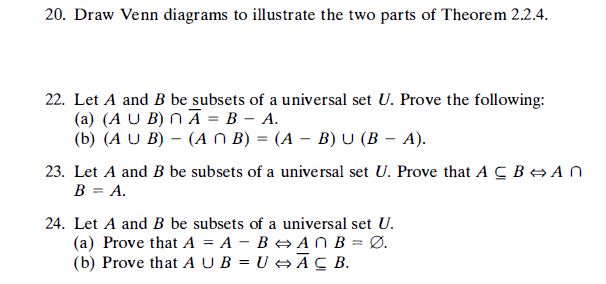
1. Let A = {1, 2, 3, 4, 5), B = {0, 1, 4, 8}, and C = {2, 5, 7, 9, 1 1, 13, 17). Compute each of the following (a) AUB. (b) AnB. (c) AnC. (d) A - B. (e) A - (BUC). (f) (A - B) U (A - C). (g) An (BUC). (h) (An B) U (An C). (i) AU(BNC). (j) (A UB) n (A UC). 2.2 COMBINING SETS 69 2. Let A, B, and C be the sets given in the previous exercise and let the universal set U = {0, 1, 2, 3, 4, .. ., 20). Compute the following. (a) A (b) B (c) AnB (d) A UB (e) AUB (f) AnB 3. (a) Let A. B, and C be the sets given in Exercise 1. Compute |A U B), |A U CI, and |B U C). (b) Let A and B be arbitrary finite sets. Based on your answers to part (a), deduce a formula for |A U B) and then prove it.13. Let A = {x E R | x = 10) and B = {x E R | x > 5}. Prove that (a) An B = (5, 10]. (b) A UB = R. (c) A - B = (-co, 5].Theorem 1.1.4 66 Let A and B he sets contained in some universal set U. 'l'hen 1.AU 3:301} 2.Ar13 AUB. PROOF: We give two proofs cf 1 and leave the Eroof of 2 as an exercise. (First Proof] We need to show two things: A U B C A ['1 B and A H B C A U B. To show.r that A U B C A D B we start by letting in E A U B. This means that .1: is not in A U B and so .1: cannot be in either A or B. l'hus x is not in A and .1: is not in B. Hence .1: E A and x E B or equivalentlyi x E A D B. This provesthatA U B; A PI 3. Cz-lAF'TFR 2' SETS Conversely. let x E A n B. 'l'hen x E A and .1: E B or equivalently .1: E A and x E B. 801 is not in eitherA or B, or in other words .1: E A U B. Hencex E A U B. 'l'husA ('1 B C A U B. It follows that A U B - A r\": E. (Second Proof] Let x E U. Let P be the statement \"x E A" and Q be the statement \".1: E B." Then P v Q is the statement \".1: E A or x E B." which means \"1: E A U B.\" So .(P v Q) is the statement \".1: E A U B" or \"x E A U B." Also .P is the statement \"x E A" or equivalently \"1: E A\" and .Q is the statement \".1: E B" or equivalently \"x E B." It follows that -Pn .Q is the statement \".1: E A and x E B\" or equivalenthr 'x E A r": B.' We saw in Section 1.2 that .{P v Q) and .P A .Q are logically equivalent statement forms. It follows that I E A U B if and onlv if: E A I": B. \".lherefore A U B A r13. ' \f28. Let Q) and I be the sets of rational and irrational numbers respectively. (a) Prove that if r E Q) and x E I, then r + x E I. (b) Prove that if r E Q), r # 0, and x E I, then rx E I.6. Express each of the following sets as an interval or a union of intervals: (a) xER x > 6} (b) {ER |x - 3 > 10 (c) ERO
Step by Step Solution
There are 3 Steps involved in it
1 Expert Approved Answer
Step: 1 Unlock
Question Has Been Solved by an Expert!
Get step-by-step solutions from verified subject matter experts
Step: 2 Unlock
Step: 3 Unlock
Students Have Also Explored These Related Mathematics Questions!












 Study Help