







Question: Let n e N and let (40, b), (2,6),..., (am, br) be n +1 points in R. We assume that 20,..., are all different. We
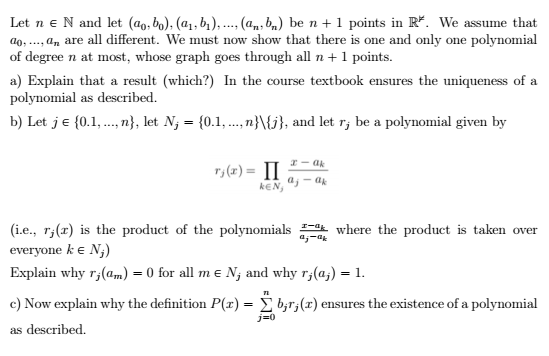
Let n e N and let (40, b), (2,6),..., (am, br) be n +1 points in R. We assume that 20,..., are all different. We must now show that there is one and only one polynomial of degree n at most, whose graph goes through all n + 1 points. a) Explain that a result (which?) In the course textbook ensures the uniqueness of a polynomial as described. b) Let je {0.1, ..., n}, let N; = {0.1,..., n}\{j}, and let rj be a polynomial given by I-a 13(x) = II aj-ak REN (i.e., r;() is the product of the polynomials where the product is taken over everyone ke N;) Explain why r;(4m) = 0 for all me N, and why r;(q;) = 1. c) Now explain why the definition P(x) = b;r;(1) ensures the existence of a polynomial (2) = bor as described. Let n e N and let (40, b), (2,6),..., (am, br) be n +1 points in R. We assume that 20,..., are all different. We must now show that there is one and only one polynomial of degree n at most, whose graph goes through all n + 1 points. a) Explain that a result (which?) In the course textbook ensures the uniqueness of a polynomial as described. b) Let je {0.1, ..., n}, let N; = {0.1,..., n}\{j}, and let rj be a polynomial given by I-a 13(x) = II aj-ak REN (i.e., r;() is the product of the polynomials where the product is taken over everyone ke N;) Explain why r;(4m) = 0 for all me N, and why r;(q;) = 1. c) Now explain why the definition P(x) = b;r;(1) ensures the existence of a polynomial (2) = bor as described
Step by Step Solution
There are 3 Steps involved in it

Get step-by-step solutions from verified subject matter experts
 Study Help