







Question: Let there is an directed graph with 5 nodes with the following edges (x-y(z) means x is connected to y, and z is the
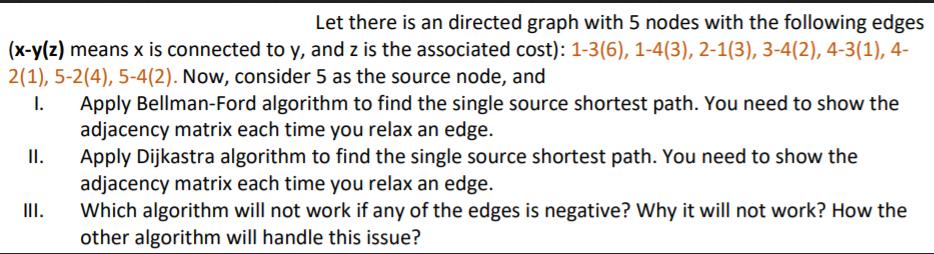
Let there is an directed graph with 5 nodes with the following edges (x-y(z) means x is connected to y, and z is the associated cost): 1-3(6), 1-4(3), 2-1(3), 3-4(2), 4-3(1), 4- 2(1), 5-2(4), 5-4(2). Now, consider 5 as the source node, and 1. II. III. Apply Bellman-Ford algorithm to find the single source shortest path. You need to show the adjacency matrix each time you relax an edge. Apply Dijkastra algorithm to find the single source shortest path. You need to show the adjacency matrix each time you relax an edge. Which algorithm will not work if any of the edges is negative? Why it will not work? How the other algorithm will handle this issue?
Step by Step Solution
There are 3 Steps involved in it

Get step-by-step solutions from verified subject matter experts
 Study Help