







Question: Let two objects of equal mass m collide. Object 1 has initial velocity , directed to the right, and object 2 is initially stationary.
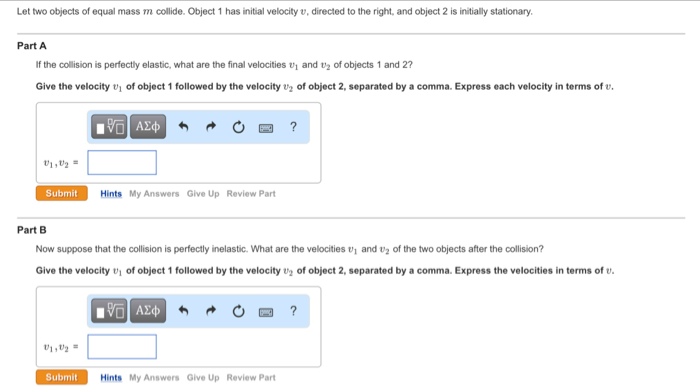
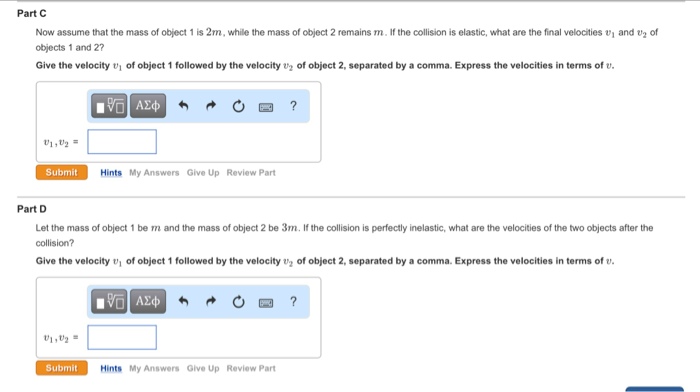
Let two objects of equal mass m collide. Object 1 has initial velocity , directed to the right, and object 2 is initially stationary. Part A If the collision is perfectly elastic, what are the final velocities and of objects 1 and 2? Give the velocity of object 1 followed by the velocity of object 2, separated by a comma. Express each velocity in terms of u. 21,0 = Submit Hints My Answers Give Up Review Part 195| V1, V = Part B Now suppose that the collision is perfectly inelastic. What are the velocities and of the two objects after the collision? Give the velocity of object 1 followed by the velocity of object 2, separated by a comma. Express the velocities in terms of u. 195] Submit ? Hints My Answers Give Up Review Part ? Part C Now assume that the mass of object 1 is 2m, while the mass of object 2 remains m. If the collision is elastic, what are the final velocities and of objects 1 and 2? Give the velocity of object 1 followed by the velocity of object 2, separated by a comma. Express the velocities in terms of u. V1, V = Submit V1, V = 195| Submit Hints My Answers Give Up Review Part Part D Let the mass of object 1 be m and the mass of object 2 be 3m. If the collision is perfectly inelastic, what are the velocities of the two objects after the collision? Give the velocity of object 1 followed by the velocity of object 2, separated by a comma. Express the velocities in terms of u. 15. ? Hints My Answers Give Up Review Part ?
Step by Step Solution
3.44 Rating (160 Votes )
There are 3 Steps involved in it
Part A For a perfectly elastic collision the final velocities of moving objectv1 and stationary object V2 will each be half the velocity of initial ve... View full answer

Get step-by-step solutions from verified subject matter experts
 Study Help