







Question: Let v be an eigenvector, with eigenvalue l, of an invertible matrix A, i.e., Av = lv. (i) Show that v is an eigenvector of
Let v be an eigenvector, with eigenvalue l, of an invertible matrix A, i.e., Av = lv.
(i) Show that v is an eigenvector of A3 and find the eigenvalue.
(ii) Show that v is an eigenvector of A?1 and find the eigenvalue.
(iii) If w is a second eigenvector, with the same eigenvalue l, then is (v+w) also an eigenvector? If so, what is the eigenvalue?
(iv) If w is a second eigenvector, with a different eigenvalue m(6= l), then is (v+w) also an eigenvector? If so, what is the eigenvalue?
(v) As in part (iv), let m(6= l) be a second eigenvalue of A. Prove that the intersection of the eigenspaces El and Em can only consist of 0. [HINT: Assume that the opposite is true, i.e., that they do intersect, and show that this leads to a contradiction.]
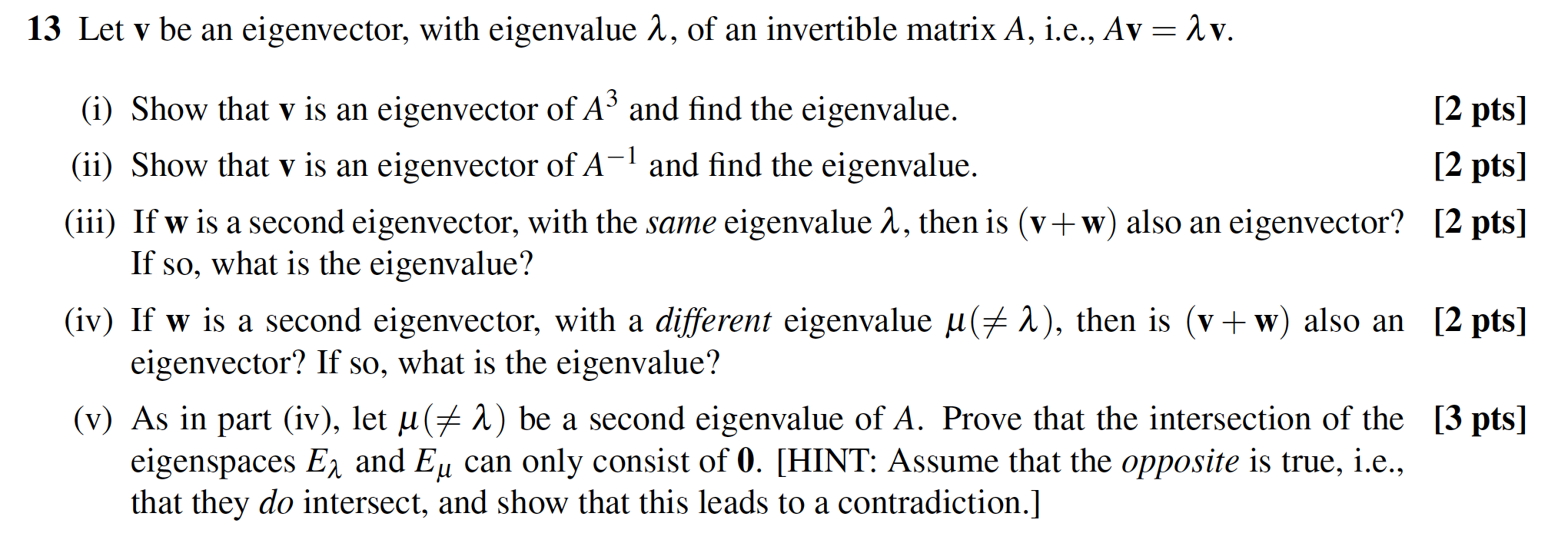
13 Let v be an eigenvector, with eigenvalue 2, of an invertible matrix A, i.e., Av = 2v. (i) Show that v is an eigenvector of A' and find the eigenvalue. [2 pts] (ii) Show that v is an eigenvector of A and find the eigenvalue. [2 pts] (iii) If w is a second eigenvector, with the same eigenvalue 2, then is (v + w) also an eigenvector? [2 pts] If so, what is the eigenvalue? (iv) If w is a second eigenvector, with a different eigenvalue u(* 2 ), then is (v + w) also an [2 pts] eigenvector? If so, what is the eigenvalue? (v) As in part (iv), let u(# 2 ) be a second eigenvalue of A. Prove that the intersection of the [3 pts] eigenspaces Ex and Eu can only consist of 0. [HINT: Assume that the opposite is true, i.e., that they do intersect, and show that this leads to a contradiction.]
Step by Step Solution
There are 3 Steps involved in it

Get step-by-step solutions from verified subject matter experts
 Study Help