







Question: Let V[y) : R > R be a continuously differentiable function. Newton's equation of motion for a particle moving in the presence of the potential
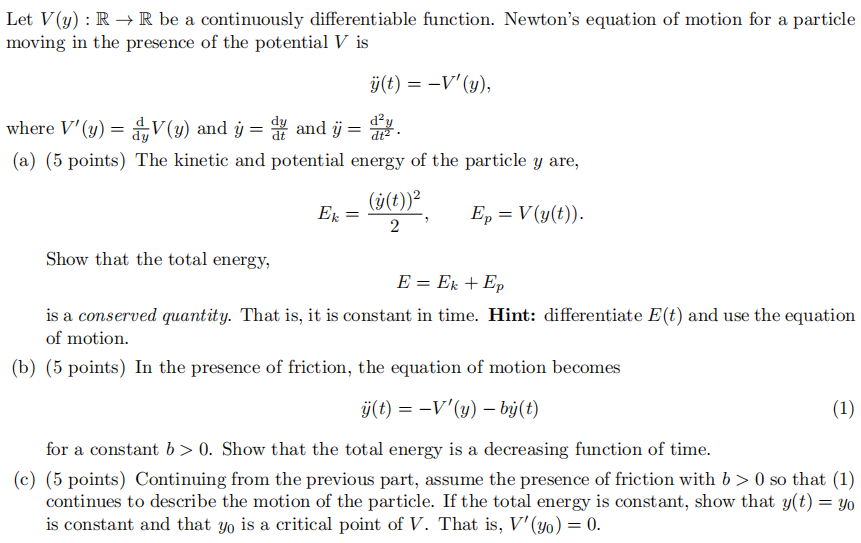
Let V[y) : R > R be a continuously differentiable function. Newton's equation of motion for a particle moving in the presence of the potential V is =VWL O lo 2 where mm = .Vis) and s = if and s = Li: - (a) {5 points) The kinetic and potential energy of the particle y are, WW2 E1: = 2 1 E]: = nyftD- Show that the total energy, E = 3,. + EF is a conserved quantity. That is, it is constant in time. Hint: dierentiate E (t) and use the equation of motion. [b) [5 points) In the presence of friction, the equation of motion becomes sift) = V'(y) - Wit) [1) for a constant I: > U. Show that the total energy is a decreasing f1mction of time. (c) [5 points) Continuing from the previous part, assume the presence of friction with b 2: D so that [1) continues to describe the motion of the particle. If the total energy is constant, show that y[t) = ya is constant and that y; is a critical point of V. That is, V'{'yg) =
Step by Step Solution
There are 3 Steps involved in it

Get step-by-step solutions from verified subject matter experts
 Study Help