Question: Let X and Y be two continuous random variables with joint probability density function f(x, y) = 12 5 xy(1 + y) for 0 ?

Let X and Y be two continuous random variables with joint probability density function

f(x, y) = 12

5 xy(1 + y) for 0 ? x ? 1 and 0 ? y ? 1,

and f(x, y) = 0 otherwise.

a. Find the probability P 1

4 ? X ? 1

2 , 1

3 ? Y ? 2

3

.

b. Determine the joint distribution function of X and Y for a and b between

0 and 1.

c. Use your answer from b to find FX(a) for a between 0 and 1.

d. Apply the rule on page 122 to find the probability density function of X

from the joint probability density function f(x, y). Use the result to verify

your answer from c.

e. Find out whether X and Y are independent.

9.11 Let X and Y be two continuous random variables, with the same

joint probability density function as in Exercise 9.10. Find the probability

P(X

9.12 The joint probability density function f of the pair (X, Y ) is given by

f(x, y) = K(3x2 + 8xy) for 0 ? x ? 1 and 0 ? y ? 2,

and f(x, y) = 0 for all other values of x and y. Here K is some positive

constant.

a. Find K.

b. Determine the probability P(2X ? Y

The technology matrix of an economic system of two industries is .

.

.

.

0 50

0 41

0 30

0 33 = G.

Test whether the system is viable as per Hawkins Simon conditions.

2. The technology matrix of an economic system of two industries is .

.

.

.

0 6

0 20

0 9

0 80 = G. Test

whether the system is viable as per Hawkins-Simon conditions.

3. The technology matrix of an economic system of two industries is .

.

.

.

0 50

0 40

0 25

0 67 = G. Test

whether the system is viable as per Hawkins-Simon conditions.

4. Two commodities A and B are produced such that 0.4 tonne of A and 0.7 tonne of B

are required to produce a tonne of A. Similarly 0.1 tonne of A and 0.7 tonne of B are

needed to produce a tonne of B. Write down the technology matrix. If 6.8 tonnes

of A and 10.2 tonnes of B are required, find the gross production of both of them.
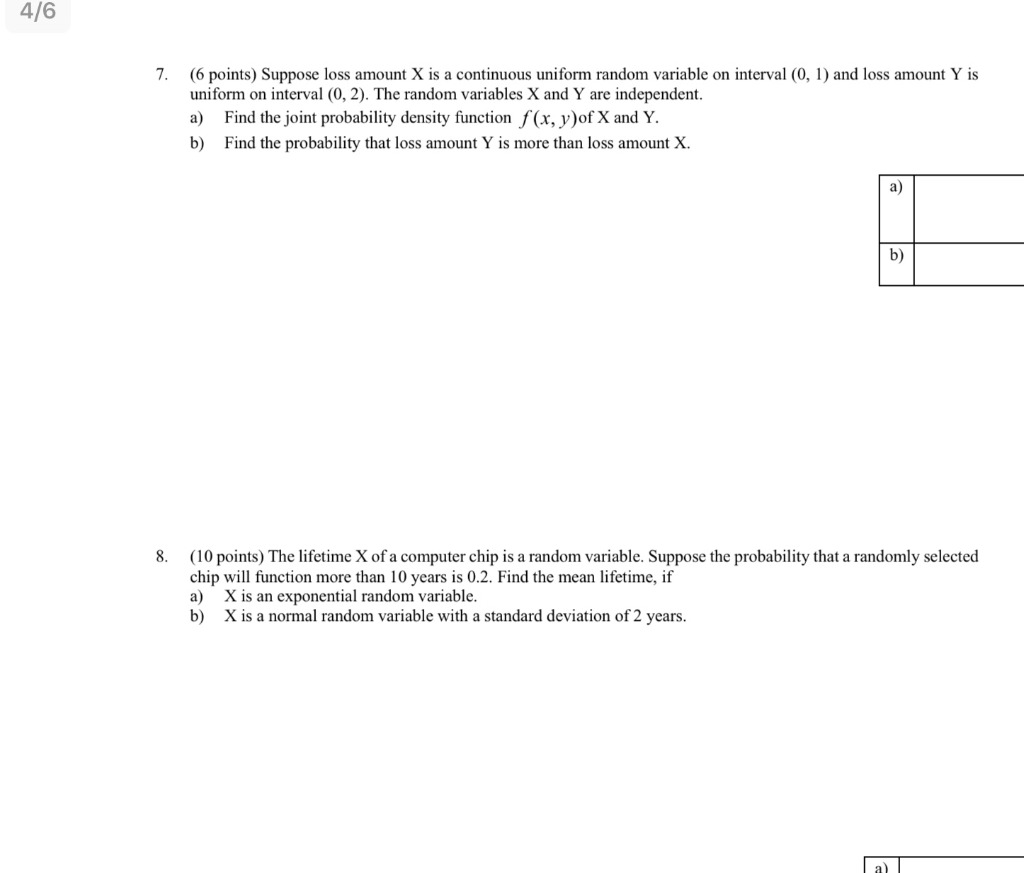
 Let X and Y be two continuous random variables with jointprobability density functionf(x, y) = 125 xy(1 + y) for 0 ?x ? 1 and 0 ? y ? 1,and f(x, y) =
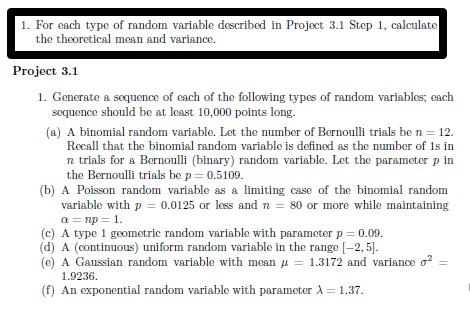
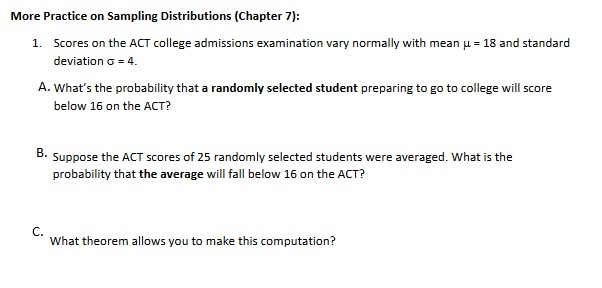
1. For each type of random variable described in Project 3.1 Step 1, calculate the theoretical mean and variance. Project 3.1 1. Generate a sequence of each of the following types of random variables; each sequence should be at least 10,000 points long- (a) A binomial random variable. Let the number of Bernoulli trials be n = 12. Recall that the binomial random variable is defined as the number of is in in trials for a Bernoulli (binary) random variable. Let the parameter p in the Bernoulli trials be p = 0.5109. (b) A Poisson random variable as a limiting case of the binomial random variable with p = 0.0125 or less and n = 80 or more while maintaining 0 = np = 1. (c) A type 1 geometric random variable with parameter p = 0.09. (d) A (continuous) uniform random variable in the range [-2, 5]. (e) A Gaussian random variable with mean / = 1.3172 and variance o' = 1.9236. (f) An exponential random variable with parameter A = 1.37.More Practice on Sampling Distributions (Chapter 7): 1. Scores on the ACT college admissions examination vary normally with mean u = 18 and standard deviation G = 4. A. What's the probability that a randomly selected student preparing to go to college will score below 16 on the ACT? B. Suppose the ACT scores of 25 randomly selected students were averaged. What is the probability that the average will fall below 16 on the ACT? C. What theorem allows you to make this computation?4/6 T. (6 points) Suppose loss amount X is a continuous uniform random variable on interval (0, l) and loss amount Y is uniform on interval (0, 2]. The random variables X and Y are independent. it) Find the joint probability density function for, y)ofX and Y. 1:) Find the probability that loss amount Y is more than loss amount X. 8. (10 points) The lifetime X of a computer chip is a random variable. Suppose the probability that a randomly selected chip will function more than 10 years is 0.2. Find the mean lifetime, if a) X is an exponential random variable. b) X is a normal random variable with a standard deviation of 2 years. la'li

Step by Step Solution

There are 3 Steps involved in it

1 Expert Approved Answer
Step: 1 Unlock blur-text-image
Question Has Been Solved by an Expert!

Get step-by-step solutions from verified subject matter experts

Step: 2 Unlock
Step: 3 Unlock

Students Have Also Explored These Related Mathematics Questions!