







Question: Let x be a random variable that represents hemoglobin count (HC) in grams per 100 milliliters of whole blood. Then x has a distribution that
Let x be a random variable that represents hemoglobin count (HC) in grams per 100 milliliters of whole blood. Then x has a distribution that is approximately normal with a population mean of 14 for healthy adult women (based on information from Diagnostic Tests with Nursing Implications, Springhouse Corporation). Suppose a female has taken 12 lab blood tests during the past year.
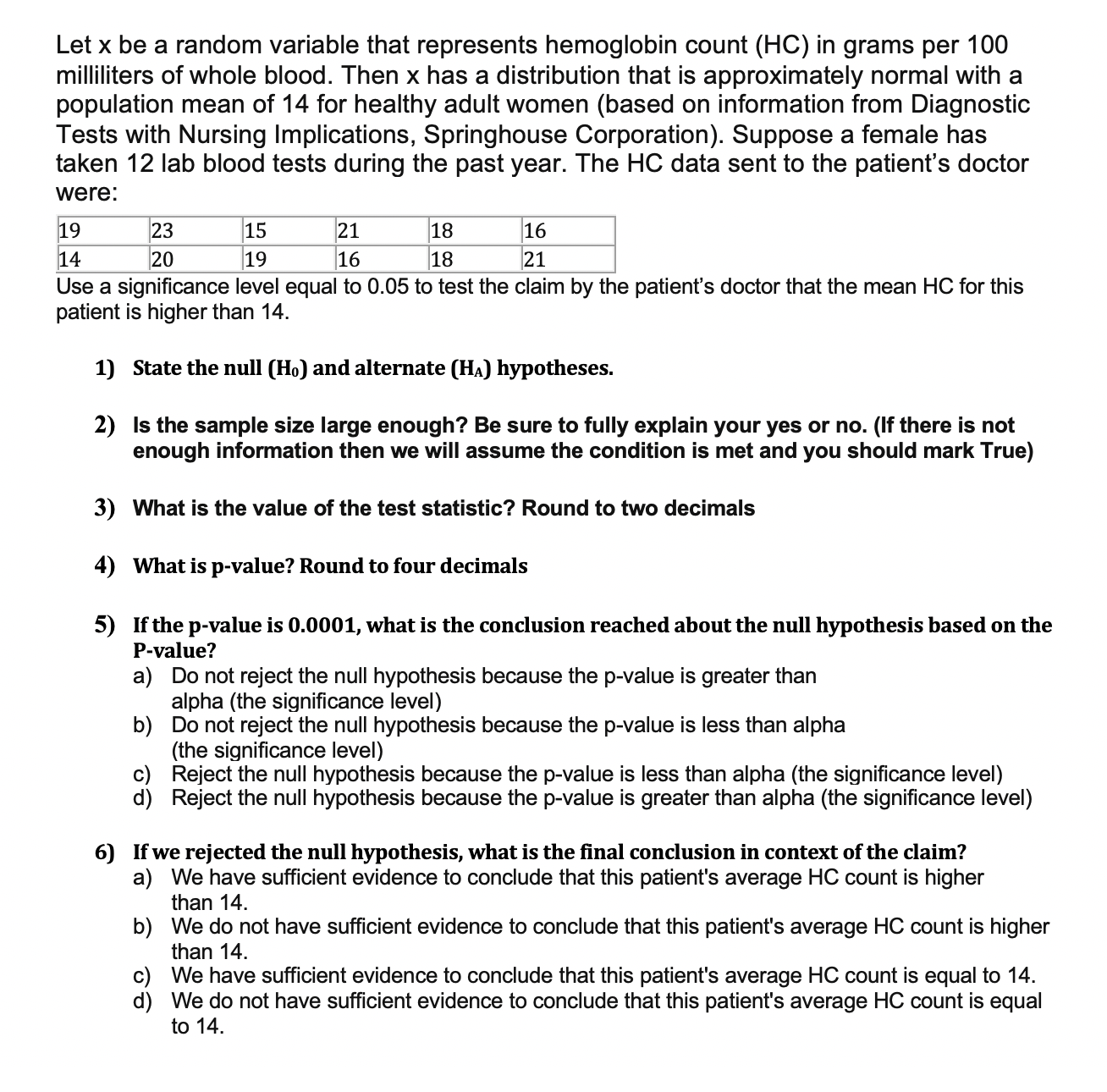
Let x be a random variable that represents hemoglobin count (HC) in grams per 100 milliliters of whole blood. Then x has a distribution that is approximately normal with a population mean of 14 for healthy adult women (based on information from Diagnostic Tests with Nursing Implications, Springhouse Corporation). Suppose a female has taken 12 lab blood tests during the past year. The HC data sent to the patient's doctor were: 19 23 15 21 18 16 14 20 19 16 18 21 Use a significance level equal to 0.05 to test the claim by the patient's doctor that the mean HC for this patient is higher than 14. 1) State the null (Ho) and alternate (HA) hypotheses. 2) Is the sample size large enough? Be sure to fully explain your yes or no. (If there is not enough information then we will assume the condition is met and you should mark True) 3) What is the value of the test statistic? Round to two decimals 4) What is p-value? Round to four decimals 5) If the p-value is 0.0001, what is the conclusion reached about the null hypothesis based on the P-value? a) Do not reject the null hypothesis because the p-value is greater than alpha (the significance level) b) Do not reject the null hypothesis because the p-value is less than alpha (the significance level) d) Reject the null hypothesis because the p-value is less than alpha (the significance level) Reject the null hypothesis because the p-value is greater than alpha (the significance level) 6) If we rejected the null hypothesis, what is the final conclusion in context of the claim? a) We have sufficient evidence to conclude that this patient's average HC count is higher than 14. p) We do not have sufficient evidence to conclude that this patient's average HC count is higher than 14. c) We have sufficient evidence to conclude that this patient's average HC count is equal to 14. d) We do not have sufficient evidence to conclude that this patient's average HC count is equal to 14
Step by Step Solution
There are 3 Steps involved in it

Get step-by-step solutions from verified subject matter experts
 Study Help