







Question: Let $X_{1}, ldots, X_{n}$ be a random sample from the $mathrm{N}left(mu_{X}, sigma_{X}^{2} ight) $ distribution, and let $Y_{1}, ldots, Y_{m} $ be a random sample
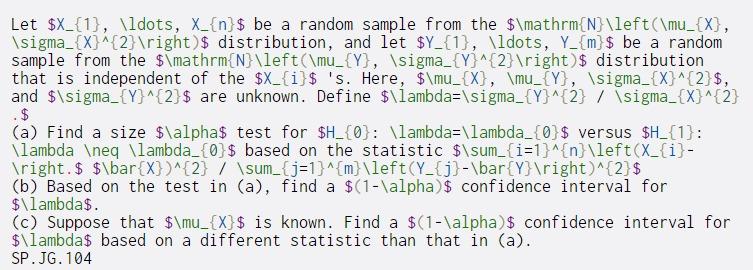
Let $X_{1}, \ldots, X_{n}$ be a random sample from the $\mathrm{N}\left(\mu_{X}, \sigma_{X}^{2} ight) $ distribution, and let $Y_{1}, \ldots, Y_{m} $ be a random sample from the $\mathrm{N}\left(\mu_{Y}, \sigma_{Y}^{2} ight) $ distribution that is independent of the $X_{i}$ 's. Here, $\mu_{X}, \mu_{Y}, \sigma_{X}^{2}$, and $\sigma_{Y}^{2}$ are unknown. Define $\lambda=\sigma_{Y}^{2} / \sigma_{X}^{2} .$ (a) Find a size $\alpha$ test for $H_{0}: \lambda=\lambda_{0}$ versus $H_{1}: \lambda eq \lambda_{0}$ based on the statistic $\sum_{i=1}^{n}\left(X_{i}- ight. $ $\bar{X})^{2} / \sum_{j=1}^{m}\left(Y_{j}-\bar{Y} ight)^{2}$ (b) Based on the test in (a), find a $(1-\alpha) $ confidence interval for $\lambda$. (c) Suppose that $\mu_{X}$ is known. Find a $(1-\alpha) $ confidence interval for $\lambda$ based on a different statistic than that in (a). SP.JG. 104
Step by Step Solution
There are 3 Steps involved in it

Get step-by-step solutions from verified subject matter experts
 Study Help