







Question: Lets consider the abstract state machine presented in Figure 1. It uses hierarchy to facilitate abstraction. Flattening the hierarchy could improve model verification periormance (i.e.,
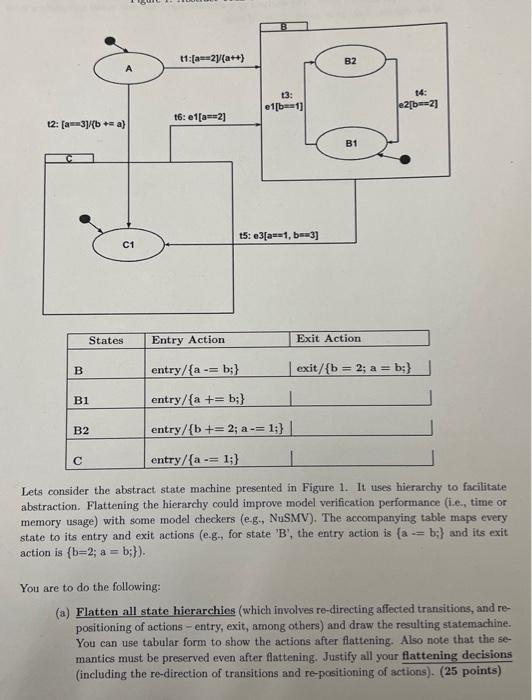
Lets consider the abstract state machine presented in Figure 1. It uses hierarchy to facilitate abstraction. Flattening the hierarchy could improve model verification periormance (i.e., time or memory usage) with some model checkers (e.g., NuSMV). The accompanying table maps every state to its entry and exit actions (e.g., for state 'B', the entry action is {a=b}} and its exit action is {b=2;a=b;}). You are to do the following: (a) Flatten all state hierarchies (which involves re-directing affected transitions, and repositioning of actions - entry, exit, among others) and draw the resulting statemachine. You can use tabular form to show the actions after flattening. Also note that the semantics must be preserved even after flattening. Justify all your flattening decisions (including the re-direction of transitions and re-pasitioning of actions). (25 points)
Step by Step Solution
There are 3 Steps involved in it

Get step-by-step solutions from verified subject matter experts
 Study Help