







Question: Lets consider the following system: For this system we can either consider mass transfer in the gasphase or the liquid, consider the two examples below:
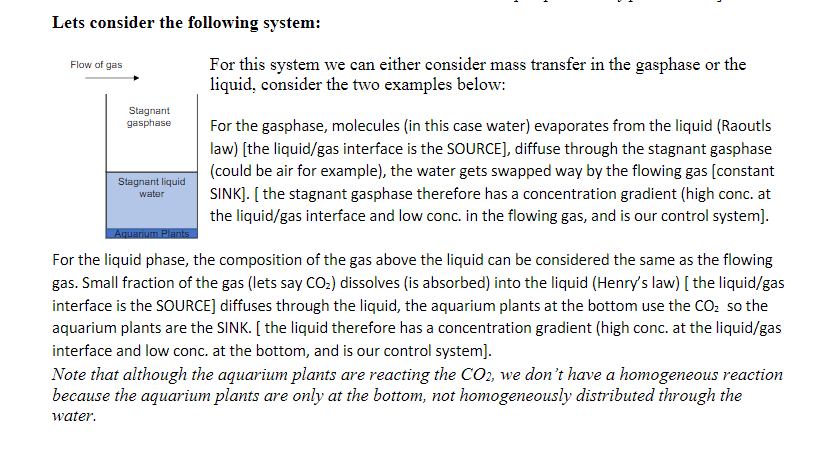
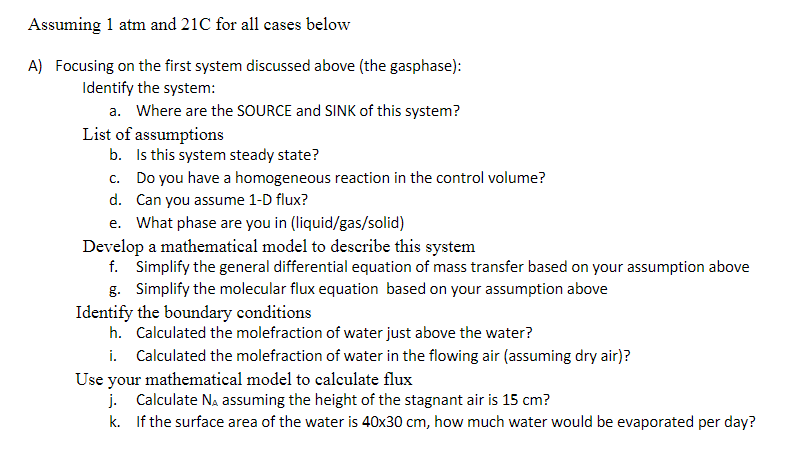
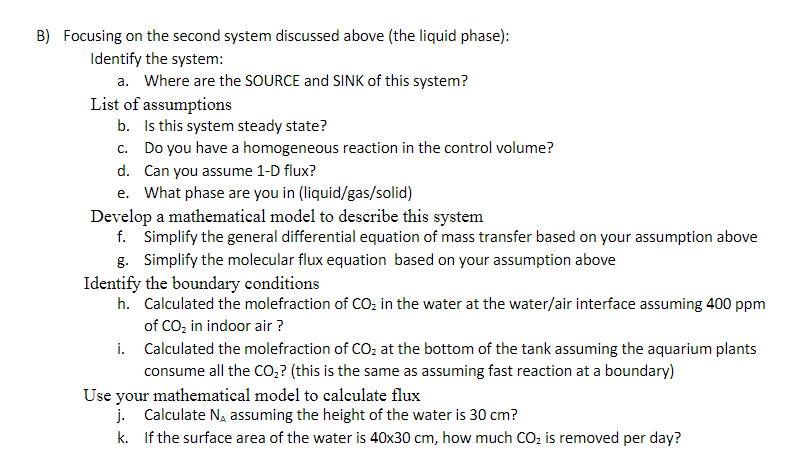
Lets consider the following system: For this system we can either consider mass transfer in the gasphase or the liquid, consider the two examples below: For the gasphase, molecules (in this case water) evaporates from the liquid (Raoutls law) [the liquid/gas interface is the SOURCE], diffuse through the stagnant gasphase (could be air for example), the water gets swapped way by the flowing gas [constant SINK]. [ the stagnant gasphase therefore has a concentration gradient (high conc. at the liquid/gas interface and low conc. in the flowing gas, and is our control system]. For the liquid phase, the composition of the gas above the liquid can be considered the same as the flowing gas. Small fraction of the gas (lets say CO2 ) dissolves (is absorbed) into the liquid (Henry's law) [ the liquid/gas interface is the SOURCE] diffuses through the liquid, the aquarium plants at the bottom use the CO2 so the aquarium plants are the SINK. [ the liquid therefore has a concentration gradient (high conc. at the liquid/gas interface and low conc. at the bottom, and is our control system]. Note that although the aquarium plants are reacting the CO2, we don't have a homogeneous reaction because the aquarium plants are only at the bottom, not homogeneously distributed through the water. suming 1atm and 21C for all cases below Focusing on the first system discussed above (the gasphase): Identify the system: a. Where are the SOURCE and SINK of this system? List of assumptions b. Is this system steady state? c. Do you have a homogeneous reaction in the control volume? d. Can you assume 1-D flux? e. What phase are you in (liquid/gas/solid) Develop a mathematical model to describe this system f. Simplify the general differential equation of mass transfer based on your assumption above g. Simplify the molecular flux equation based on your assumption above Identify the boundary conditions h. Calculated the molefraction of water just above the water? i. Calculated the molefraction of water in the flowing air (assuming dry air)? Use your mathematical model to calculate flux j. Calculate NA assuming the height of the stagnant air is 15cm ? k. If the surface area of the water is 4030cm, how much water would be evaporated per day? Focusing on the second system discussed above (the liquid phase): Identify the system: a. Where are the SOURCE and SINK of this system? List of assumptions b. Is this system steady state? c. Do you have a homogeneous reaction in the control volume? d. Can you assume 1-D flux? e. What phase are you in (liquid/gas/solid) Develop a mathematical model to describe this system f. Simplify the general differential equation of mass transfer based on your assumption above g. Simplify the molecular flux equation based on your assumption above Identify the boundary conditions h. Calculated the molefraction of CO2 in the water at the water/air interface assuming 400ppm of CO2 in indoor air ? i. Calculated the molefraction of CO2 at the bottom of the tank assuming the aquarium plants consume all the CO2 ? (this is the same as assuming fast reaction at a boundary) Use your mathematical model to calculate flux j. Calculate NA assuming the height of the water is 30cm ? k. If the surface area of the water is 4030cm, how much CO2 is removed per day
Step by Step Solution
There are 3 Steps involved in it

Get step-by-step solutions from verified subject matter experts
 Study Help