







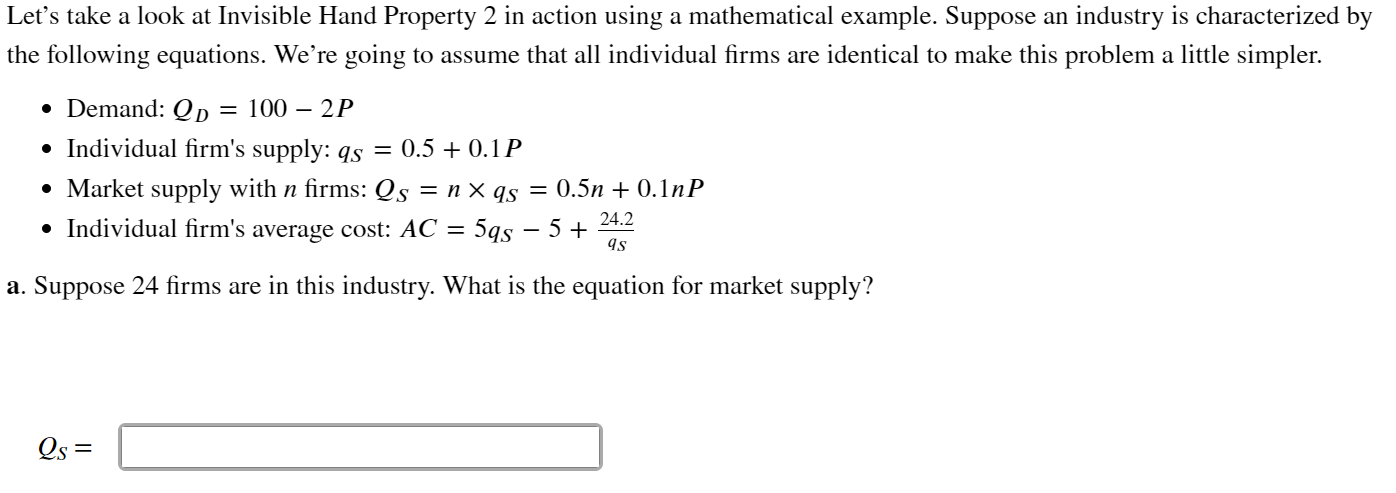
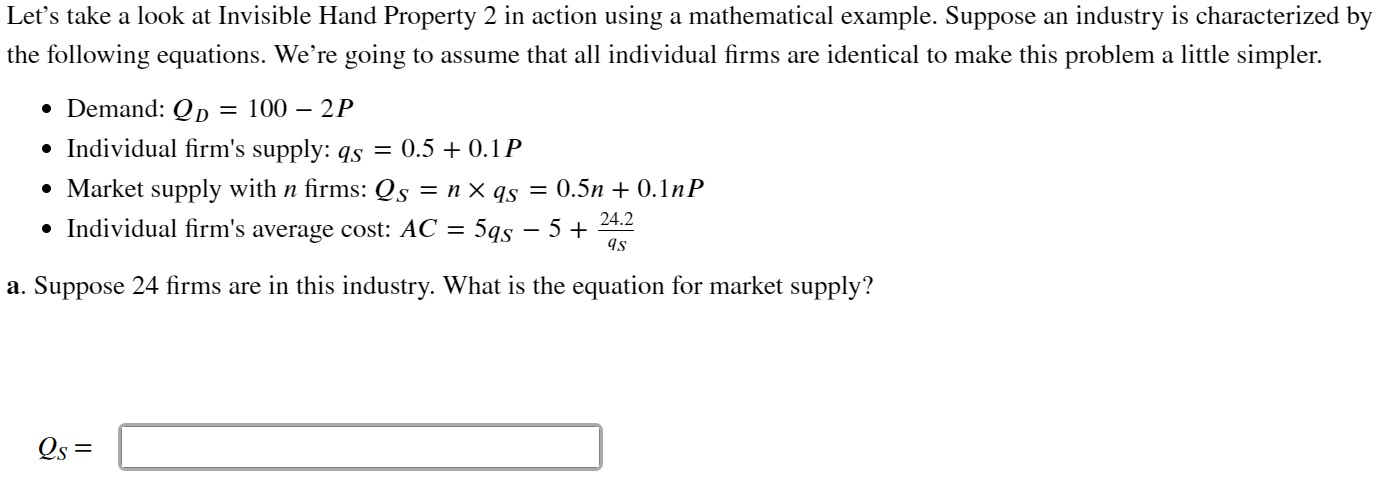
Question: Let's take a look at Invisible Hand Property 2 in action using a mathematical example. Suppose an industry is characterized by the following equations. We're
![with :2 rms: Q5 2 n X (13 = 0.5}? + 0.]nP](https://s3.amazonaws.com/si.experts.images/answers/2024/06/667ca236861b5_022667ca23675165.jpg)
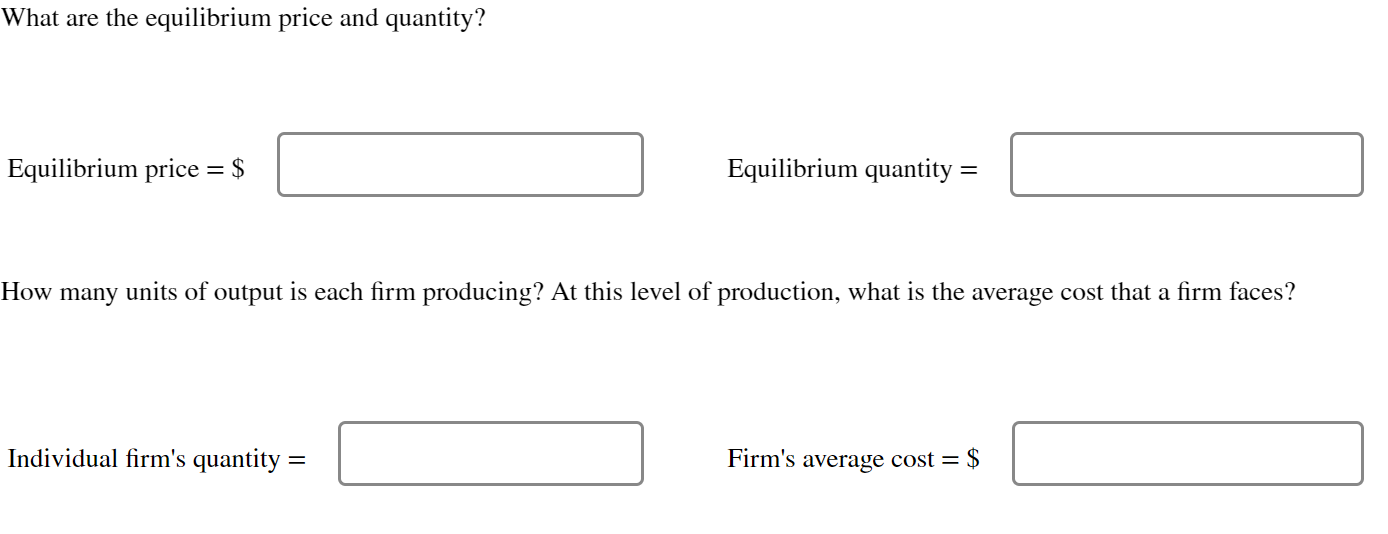
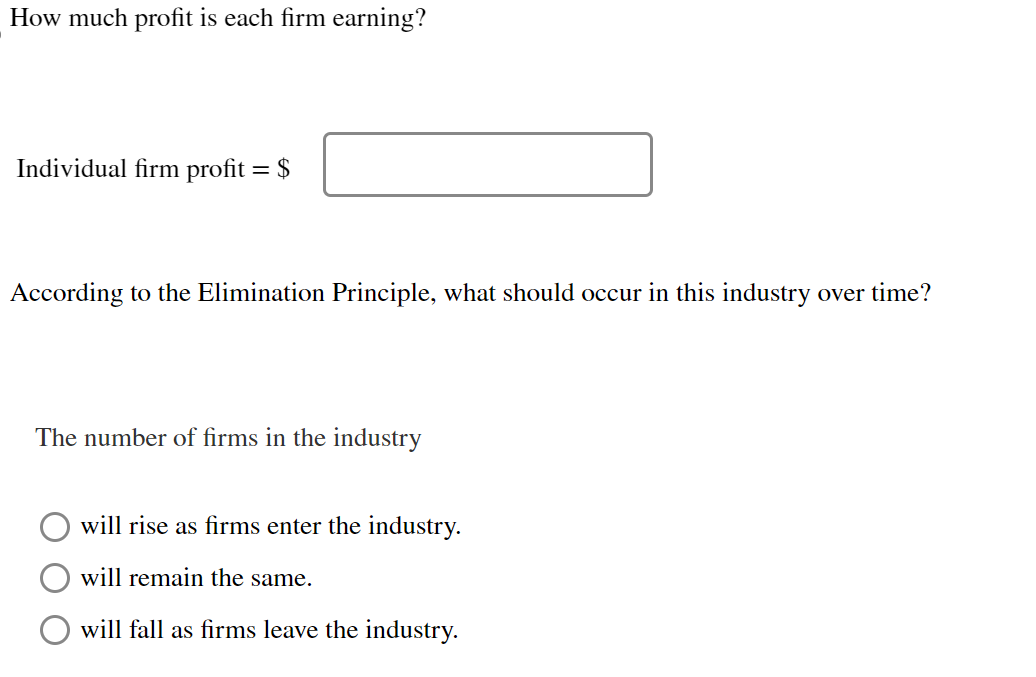
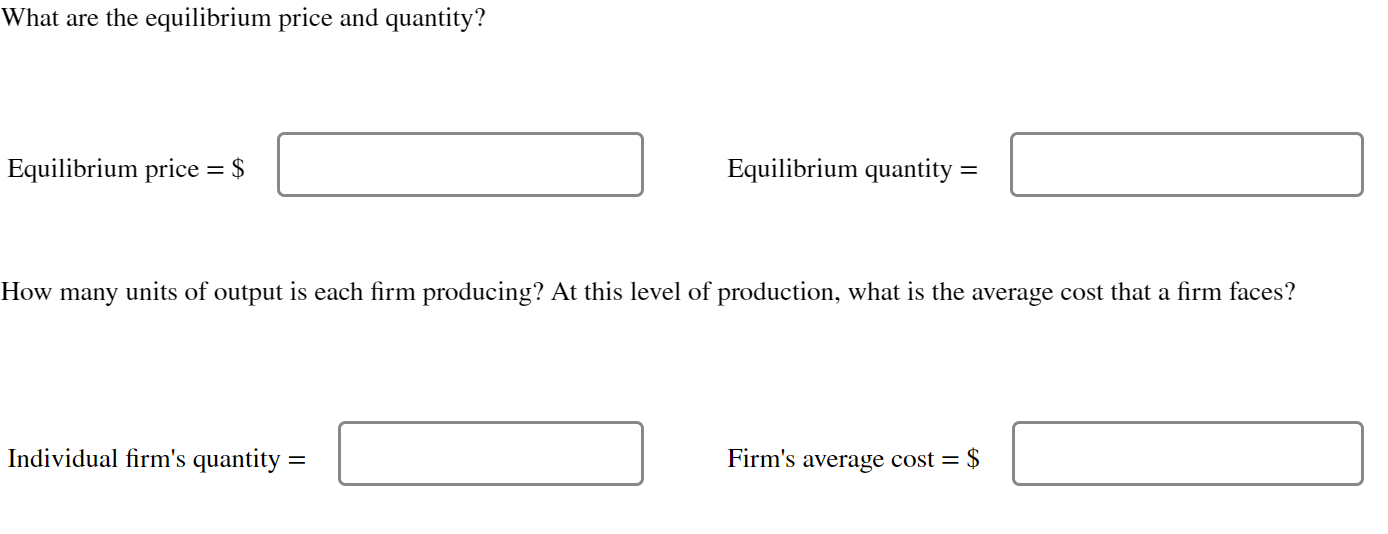
Let's take a look at Invisible Hand Property 2 in action using a mathematical example. Suppose an industry is characterized by the following equations. We're going to assume that all individual rms are identical to make this problem a little simpler. 0 Demand: QB = 100 2P 0 Individual rm's supply: 115 = 0.5 + 0.1P 0 Market supply with :2 rms: Q5 2 n X (13 = 0.5}? + 0.]nP 24.2 I Individual rm's average cost: AC 2 figs 5 + Ts a. Suppose 24 rms are in this industry. What is the equation for market supply? Q5: l What are the equilibrium price and quantity? Equilibrium price 2 $ Equilibrium quantity 2 How many units of output is each rm producing? At this level of production, what is the average cost that a rm faces? How much prot is each rm earning? According to the Elimination Principle, what should occur in this industry over time? The number of rms in the industry 0 will rise as rms enter the industry. 0 will remain the same. O will fall as rms leave the industry
Step by Step Solution
There are 3 Steps involved in it

Get step-by-step solutions from verified subject matter experts
 Study Help