







Question: Linear Algebra 2.6. Elimination = Factorization: A = LU 107 19 Suppose you eliminate upwards (almost unheard of). Use the last row to produce zeros
Linear Algebra
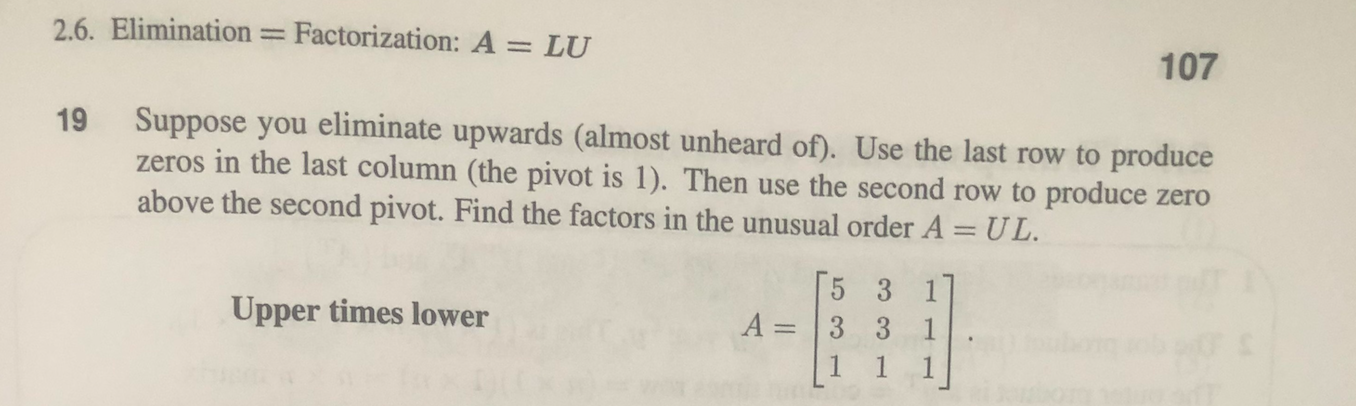
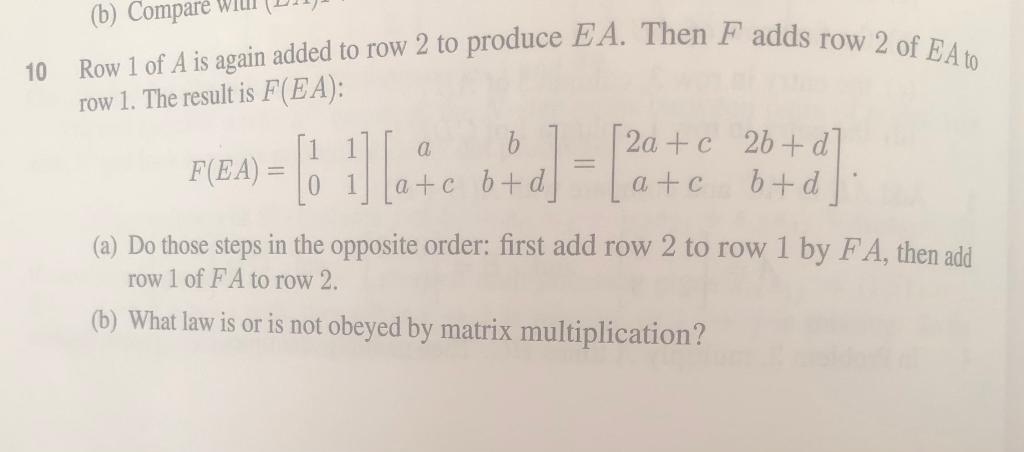
2.6. Elimination = Factorization: A = LU 107 19 Suppose you eliminate upwards (almost unheard of). Use the last row to produce zeros in the last column (the pivot is 1). Then use the second row to produce zero above the second pivot. Find the factors in the unusual order A = UL. 1 Upper times lower 15 3 A= 13 3 1 1 (b) Compare 10 row 1. The result is F(EA): Row 1 of 4 is again added to row 2 to produce EA. Then F adds row 2 of EA to F(EA) = 16 1] (afce 6 [2a +c 26+d] atc btd atc b + di (a) Do those steps in the opposite order: first add row 2 to row 1 by FA, then add row 1 of F A to row 2. (b) What law is or is not obeyed by matrix multiplication? 2.6. Elimination = Factorization: A = LU 107 19 Suppose you eliminate upwards (almost unheard of). Use the last row to produce zeros in the last column (the pivot is 1). Then use the second row to produce zero above the second pivot. Find the factors in the unusual order A = UL. 1 Upper times lower 15 3 A= 13 3 1 1 (b) Compare 10 row 1. The result is F(EA): Row 1 of 4 is again added to row 2 to produce EA. Then F adds row 2 of EA to F(EA) = 16 1] (afce 6 [2a +c 26+d] atc btd atc b + di (a) Do those steps in the opposite order: first add row 2 to row 1 by FA, then add row 1 of F A to row 2. (b) What law is or is not obeyed by matrix multiplication
Step by Step Solution
There are 3 Steps involved in it

Get step-by-step solutions from verified subject matter experts
 Study Help