







Question: linear algebra 4. At the right is pictured a 2-node dynamical system. At each time step: an individual on X 0.2 4 . . ..
linear algebra
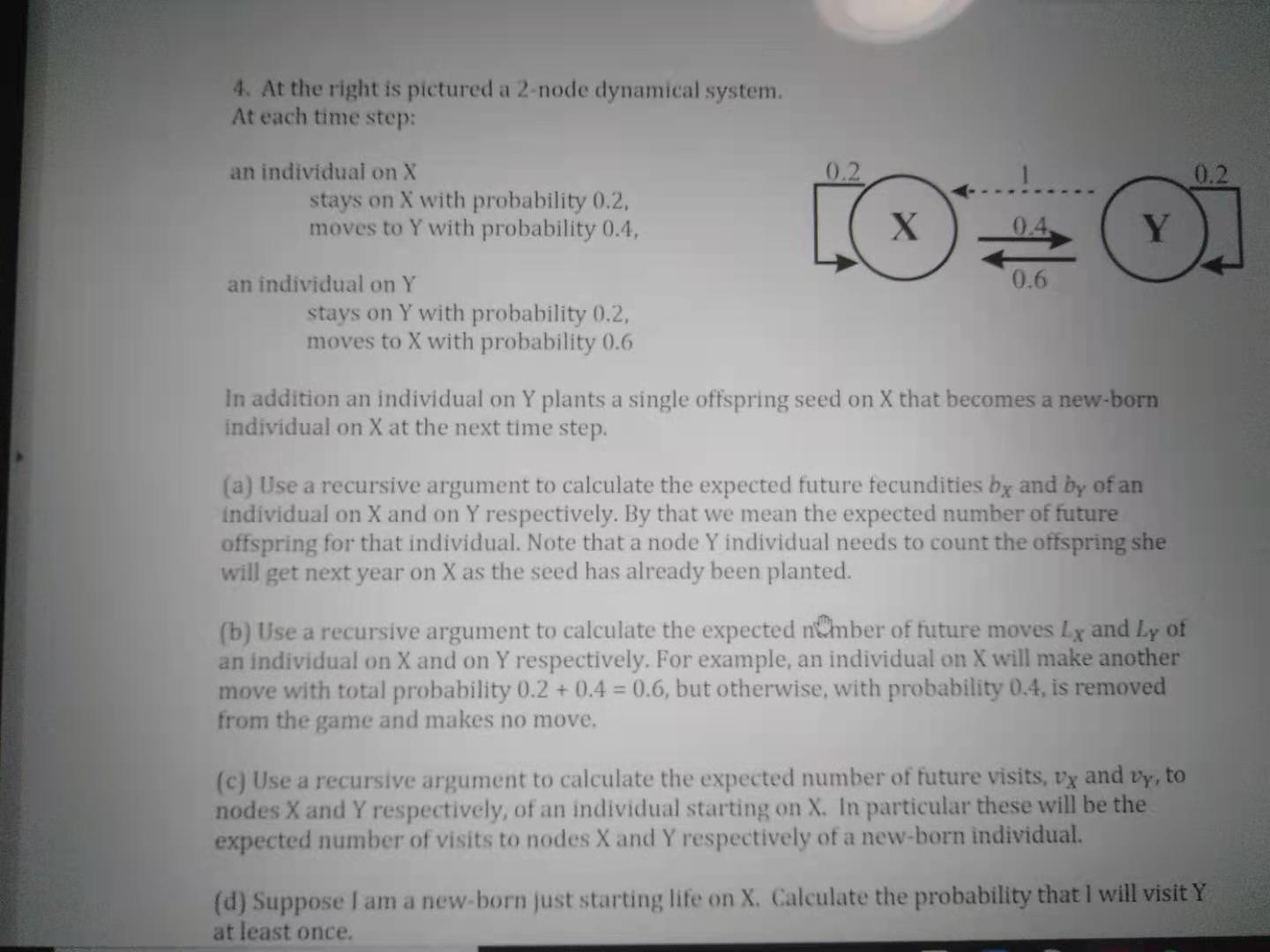
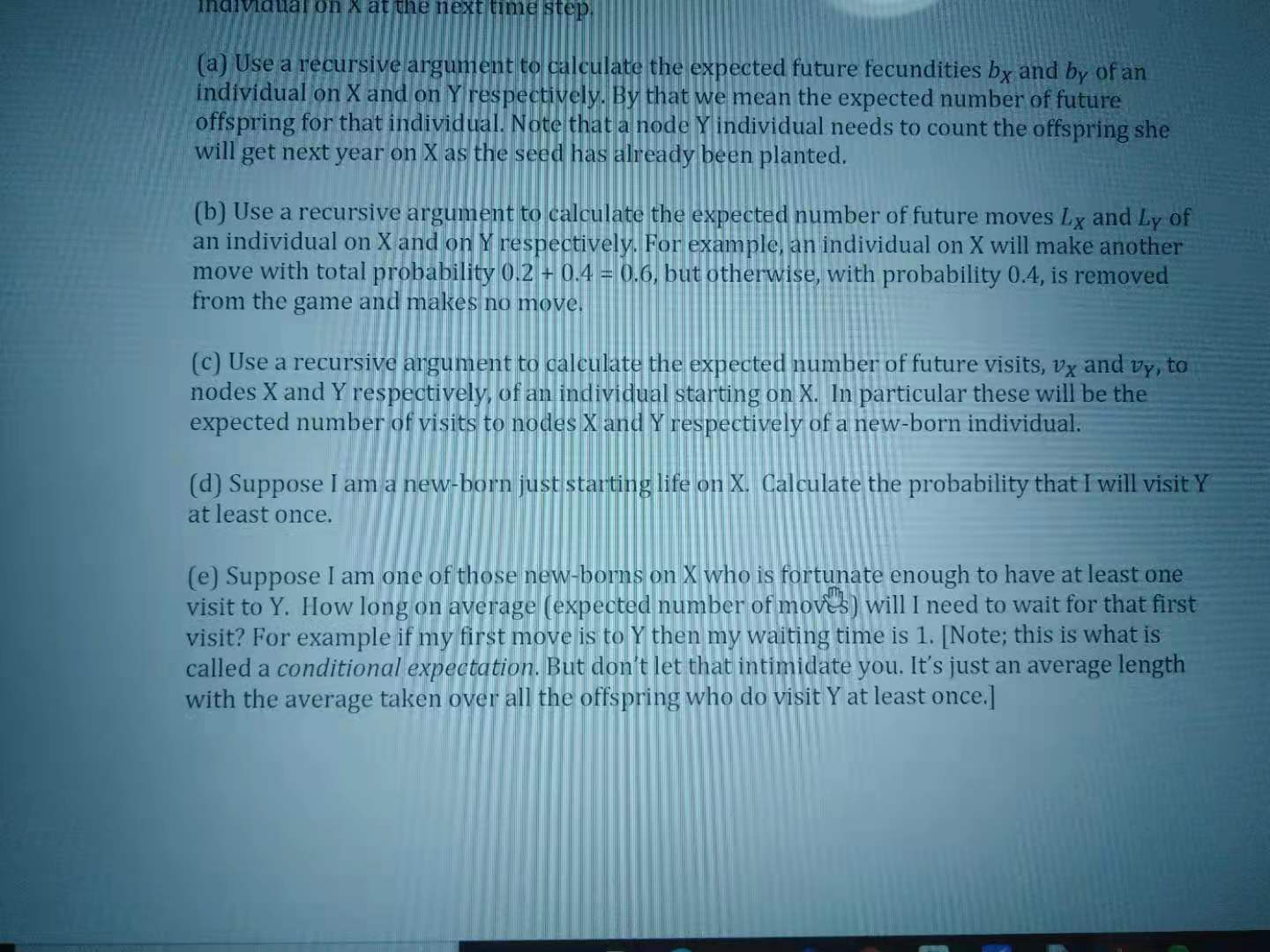
4. At the right is pictured a 2-node dynamical system. At each time step: an individual on X 0.2 4 . . .. ..... 0.2 stays on X with probability 0.2. moves to Y with probability 0.4, X 0.4. Y an individual on Y 0.6 stays on Y with probability 0.2, moves to X with probability 0.6 In addition an individual on Y plants a single offspring seed on X that becomes a new-born individual on X at the next time step. (a) Use a recursive argument to calculate the expected future fecundities by and by of an individual on X and on Y respectively. By that we mean the expected number of future offspring for that individual. Note that a node Y individual needs to count the offspring she will get next year on X as the seed has already been planted. (b) Use a recursive argument to calculate the expected number of future moves Ly and Ly of an individual on X and on Y respectively. For example, an individual on X will make another move with total probability 0.2 + 0.4 =0.6, but otherwise, with probability 0.4, is removed from the game and makes no move. (c) Use a recursive argument to calculate the expected number of future visits, Vx and vy, to nodes X and Y respectively, of an individual starting on X. In particular these will be the expected number of visits to nodes X and Y respectively of a new-born individual. (d) Suppose I am a new-born just starting life on X. Calculate the probability that I will visit Y at least once.(a) Use a recursive argument to calculate the expected future fecundities by and by of an individual on X and on Y respectively. By that we mean the expected number of future offspring for that individual. Note that a node Y individual needs to count the offspring she will get next year on X as the seed has already been planted. (b) Use a recursive argument to calculate the expected number of future moves Ly and Ly of an individual on X and on Y respectively. For example, an individual on X will make another move with total probability 0.2 + 0.4 = 0.6, but otherwise, with probability 0.4, is removed from the game and makes no move. (c) Use a recursive argument to calculate the expected number of future visits, Vx and vy, to nodes X and Y respectively, of an individual starting on X. In particular these will be the expected number of visits to nodes X and Y respectively of a new-born individual. (d) Suppose I am a new-born just starting life on X. Calculate the probability that I will visit Y at least once. (e) Suppose I am one of those new-borns on X who is fortunate enough to have at least one visit to Y. How long on average (expected number of moves ) will I need to wait for that first visit? For example if my first move is to Y then my waiting time is 1. [Note; this is what is called a conditional expectation. But don't let that intimidate you. It's just an average length with the average taken over all the offspring who do visit Y at least once.]
Step by Step Solution
There are 3 Steps involved in it

Get step-by-step solutions from verified subject matter experts
 Study Help