







Question: (Linear Systems: Applications). A certain factory has four machines A, B, C and D. The factory management recently developed the following preventive maintenance plan
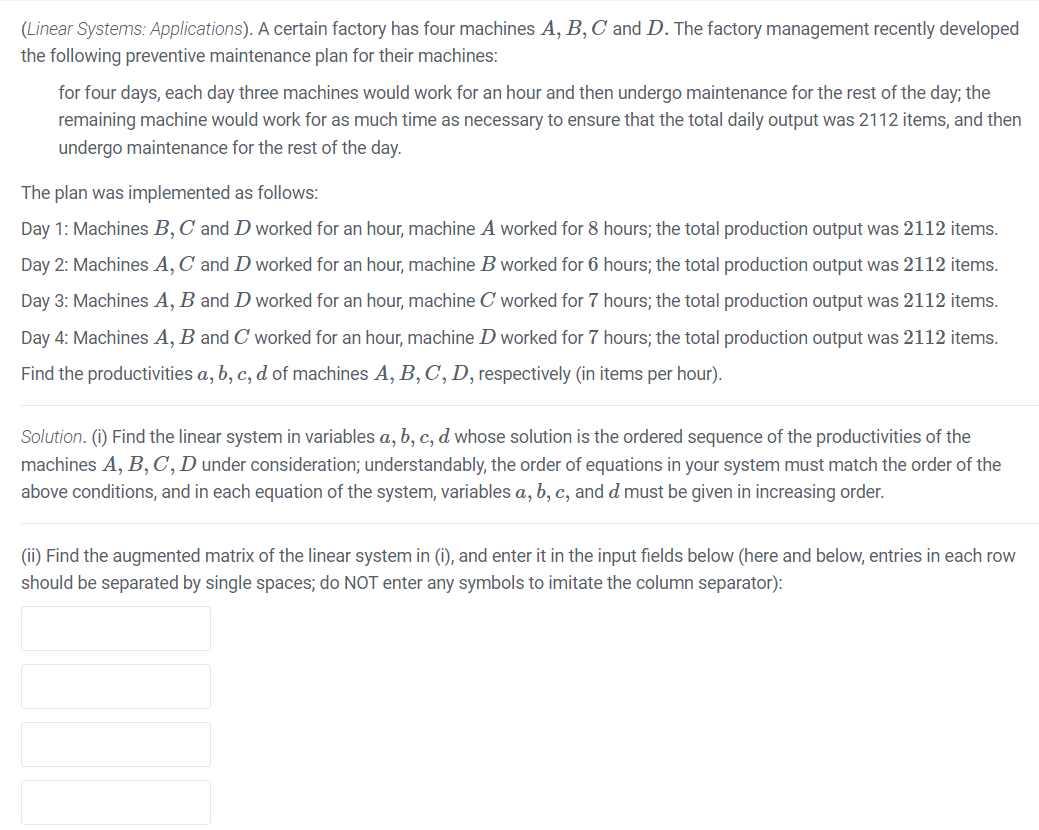
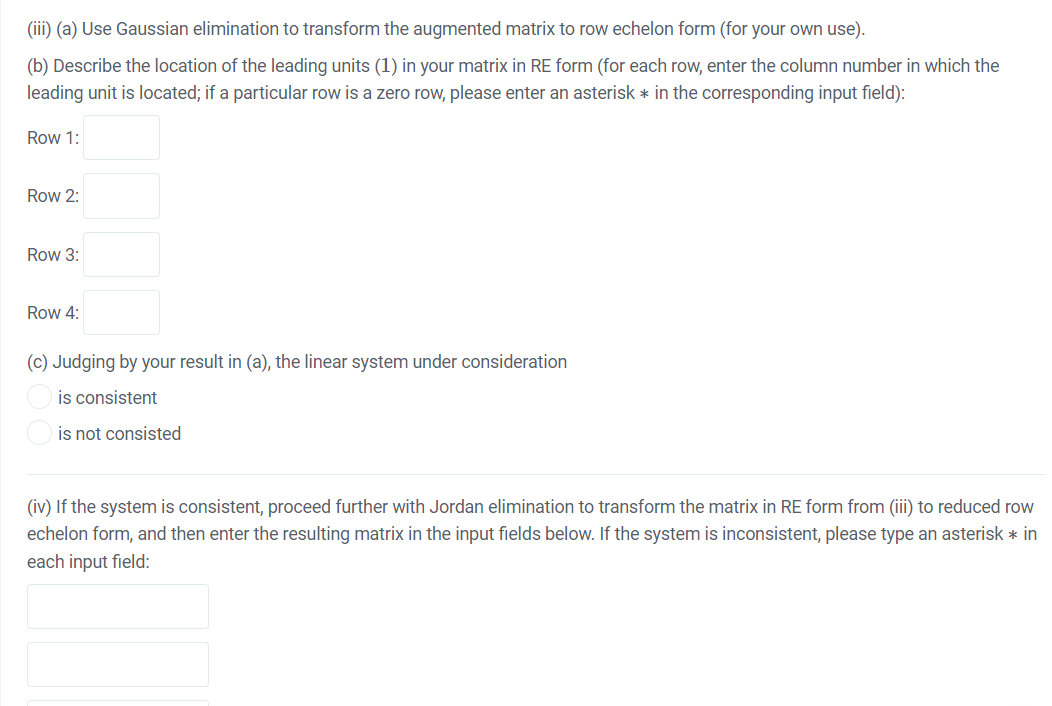
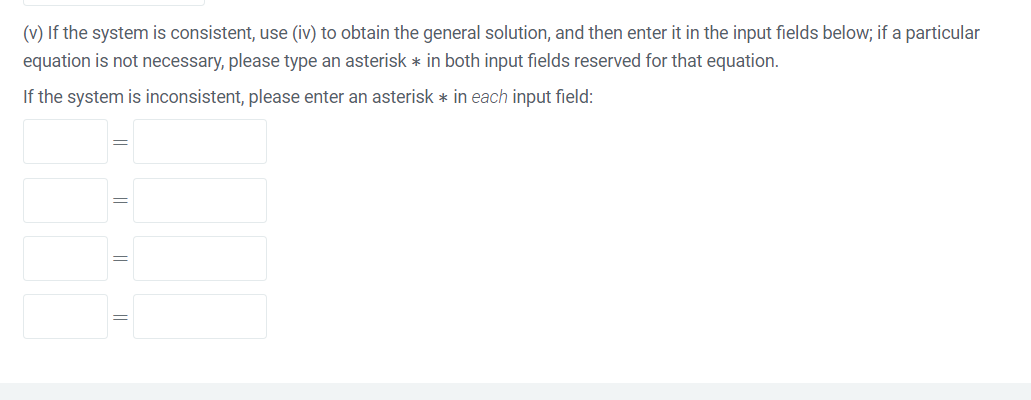
(Linear Systems: Applications). A certain factory has four machines A, B, C and D. The factory management recently developed the following preventive maintenance plan for their machines: for four days, each day three machines would work for an hour and then undergo maintenance for the rest of the day; the remaining machine would work for as much time as necessary to ensure that the total daily output was 2112 items, and then undergo maintenance for the rest of the day. The plan was implemented as follows: Day 1: Machines B, C and D worked for an hour, machine A worked for 8 hours; the total production output was 2112 items. Day 2: Machines A, C and D worked for an hour, machine B worked for 6 hours; the total production output was 2112 items. Day 3: Machines A, B and D worked for an hour, machine C worked for 7 hours; the total production output was 2112 items. Day 4: Machines A, B and C worked for an hour, machine D worked for 7 hours; the total production output was 2112 items. Find the productivities a, b, c, d of machines A, B, C, D, respectively (in items per hour). Solution. (i) Find the linear system in variables a, b, c, d whose solution is the ordered sequence of the productivities of the machines A, B, C, D under consideration; understandably, the order of equations in your system must match the order of the above conditions, and in each equation of the system, variables a, b, c, and d must be given in increasing order. (ii) Find the augmented matrix of the linear system in (i), and enter it in the input fields below (here and below, entries in each row should be separated by single spaces; do NOT enter any symbols to imitate the column separator): (iii) (a) Use Gaussian elimination to transform the augmented matrix to row echelon form (for your own use). (b) Describe the location of the leading units (1) in your matrix in RE form (for each row, enter the column number in which the leading unit is located; if a particular row is a zero row, please enter an asterisk * in the corresponding input field): Row 1: Row 2: Row 3: Row 4: (c) Judging by your result in (a), the linear system under consideration is consistent is not consisted (iv) If the system is consistent, proceed further with Jordan elimination to transform the matrix in RE form from (iii) to reduced row echelon form, and then enter the resulting matrix in the input fields below. If the system is inconsistent, please type an asterisk * in each input field: (v) If the system is consistent, use (iv) to obtain the general solution, and then enter it in the input fields below; if a particular equation is not necessary, please type an asterisk * in both input fields reserved for that equation. If the system is inconsistent, please enter an asterisk * in each input field:
Step by Step Solution
3.42 Rating (152 Votes )
There are 3 Steps involved in it
To solve this system of equations we can represent the total production output per day as a linear system where each machines productivity is a variable Based on the information provided we can set up ... View full answer

Get step-by-step solutions from verified subject matter experts
 Study Help